History

Nikita Tsybikov
Historian
"Let him kill, as long as he rules"
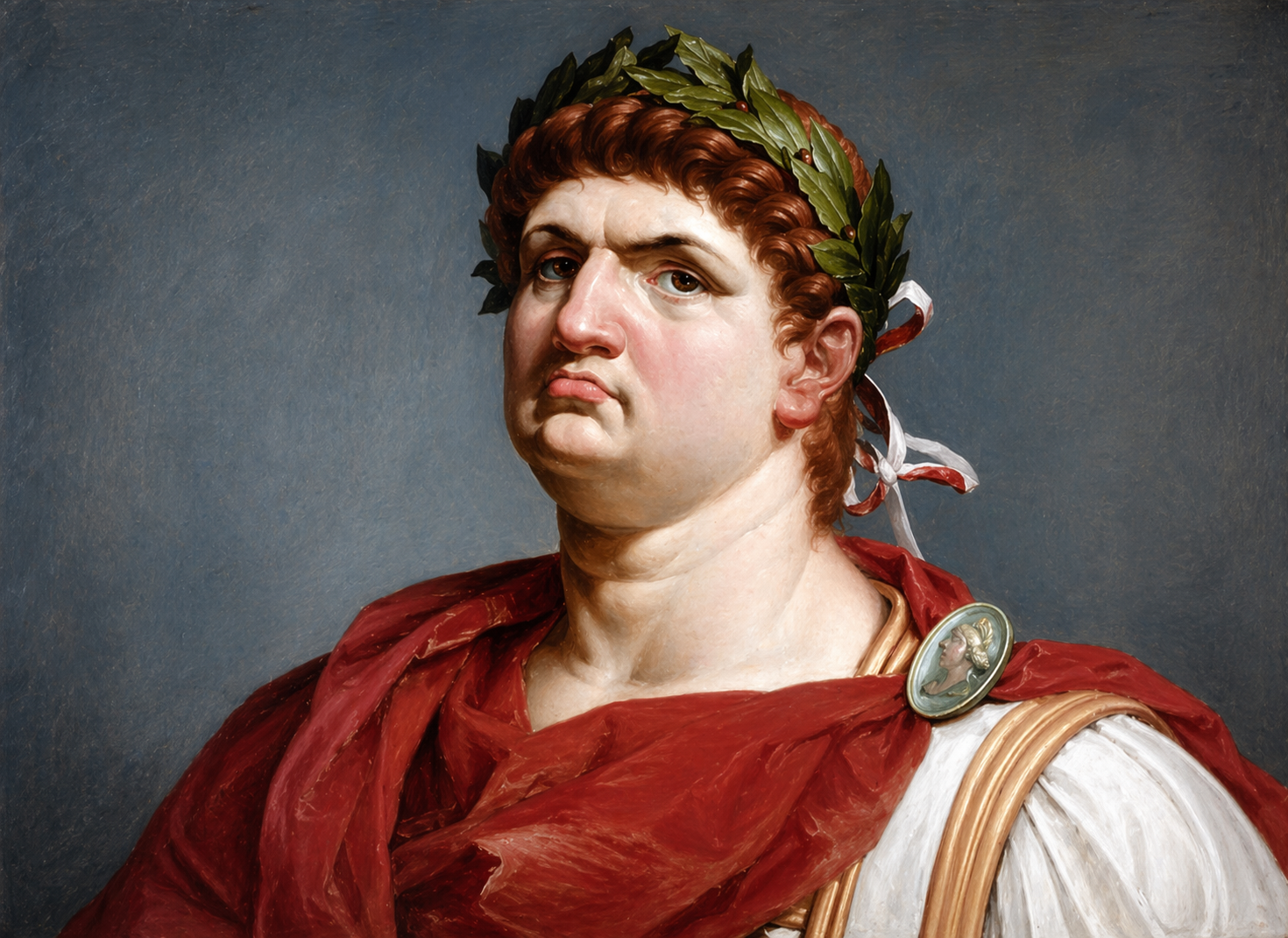
On December 15, 37 AD, Agrippina the Younger gave birth to a boy named Lucius from Gnaeus Domitius Ahenobarbus. This happened nine months after Agrippina's brother, Caligula, became the Roman emperor, so, as historian I. O. Knyazkov aptly noted, Lucius was a "child of Caligula's reign."
The boy's great-grandfather timely sided with Octavian, securing a place for the family in the new imperial elite. His grandfather became related to the house of Caesars by marrying Antonia the Elder, Augustus's niece. Thus, Lucius's father was a grandnephew to the first emperor, and his mother was his great-granddaughter. According to Suetonius, after the birth of his son, Gnaeus allegedly said that "nothing could be born from him and Agrippina except horror and grief for humanity" – a dubious testimony, more likely indicating how much historians wanted to portray even the infancy of the future emperor in an unflattering light.
Shortly after Lucius's birth, his mother was exiled for participating in a conspiracy against her own brother, and his father died of illness, so the boy was sent to his aunt. But already in 41 AD, Caligula was killed, and Lucius was reunited with his mother.
Being a cruel and domineering woman, Agrippina saw her son as a tool for gaining power. According to Tacitus, in response to a prophecy about her death at the hands of her son, she replied: "Let him kill, as long as he rules" – probably apocryphal, but conveying her character. At the court of the new emperor – her uncle Claudius – Agrippina began to intrigue against his wife Messalina, who was eventually executed in 48 AD.
The influential freedman Pallas, at Agrippina's instigation, convinced the emperor to marry his own niece. Lucius was adopted by his great-uncle Claudius and received the name Nero Claudius Caesar, under which he remained in history. Moreover, the adopted son of the emperor married his own daughter Octavia.
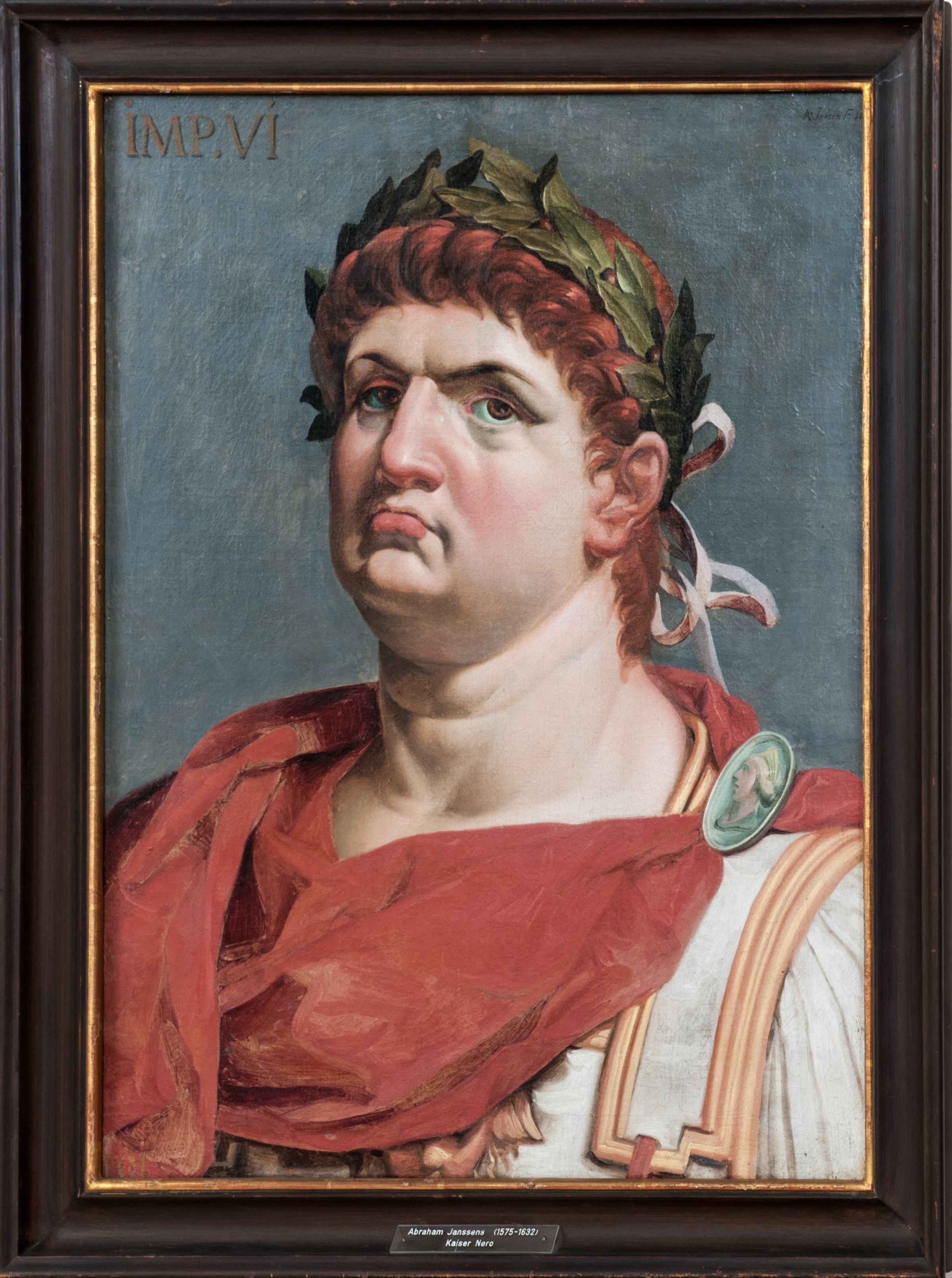
The young man's mentor was the philosopher Seneca. Nero received an excellent education, as evidenced by his genuine passion for poetry, music, and Hellenic culture. However, the troubling atmosphere of constant intrigues in the Julio-Claudian dynasty undoubtedly affected his character. Under different circumstances, Nero could have become a true "philosopher on the throne," but circumstances turned out otherwise.
Power and Mother
On October 13, 54 AD, Claudius died – either from Agrippina's poison or from old age. The emperor never managed to make a final choice between his biological son Britannicus from his former wife Messalina and his adopted son Nero from his current wife Agrippina. However, at the time of Claudius's death, his closest confidant and Britannicus's ally named Narcissus was absent from the capital, so Agrippina easily secured the support of the Praetorian Prefect Burrus, whose Praetorians proclaimed the 16-year-old Nero as the new princeps. Claudius's will was never published, and Narcissus was executed.
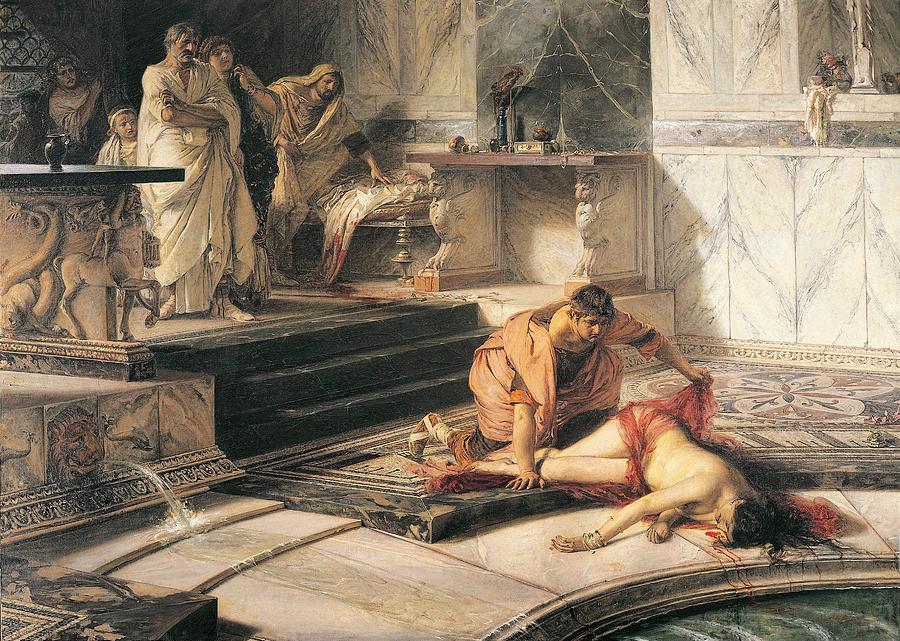
Having placed the young emperor on the throne, Agrippina immediately quarreled with the tandem of Seneca and Burrus, intending to rule the entire empire through her son. However, the philosopher and the Praetorian Prefect managed to win Nero over to their side. Then Agrippina began to support Britannicus as a replacement for her own son, but the emperor, with the consent of his mentors, ordered the rival to be poisoned. Then Nero dismissed his mother's ally Pallas, and stripped Agrippina of honors, forcing her to leave Rome. In 59 AD, the emperor, again with the consent of his mentors, ordered the killing of his own mother as a source of endless intrigues.
After Agrippina survived a staged shipwreck, a detachment led by the fleet prefect Anicetus was sent to her villa. According to legend, before her death, she exclaimed for the soldiers to strike her in the womb that bore the emperor, after which she was stabbed with swords.
"Glorious Five Years"
However, Nero's reign was marked not only by intrigues. According to Aurelius Victor, even Emperor Trajan called the first five years of Nero "golden." It is commonly believed that the successes of this period are solely due to the wisdom of his mentors. Although ancient tradition exaggerates their influence, the closeness of Seneca and Burrus to the emperor is undeniable. The "Golden Five Years" from 54 to 59 AD indeed coincided with the period of their greatest influence.
The tutor Seneca composed a treatise "On Mercy" for his ward, in which he acknowledged the leading role of the princeps but emphasized the need to follow republican virtues—moderation and mercy. Indeed, in the early years of his reign, the young emperor showed restraint. In state affairs, he relied less on freedmen and once again elevated the Senate, which even resumed minting coins with the legend "E X SC" (ex senatus consulto).
One of Nero's chosen areas of activity was the fight against tax collectors and corrupt officials. He created a consular commission to curb abuses and also carried out a tax reform, reducing and abolishing some taxes to increase the efficiency of others. The emperor fought for the rights of provincials against corrupt governors, which went against the common Roman view of provinces solely as sources of profit.
Incidentally, a striking example of such exploitative attitudes was... the renowned philosopher Seneca himself. In just four years of service to the emperor, Seneca's fortune, according to Tacitus and Dio Cassius, reached 300 million sesterces, which the philosopher earned through usury. According to one version, the famous Boudicca uprising in Britain was provoked by Seneca lending large sums to British leaders and then unexpectedly and insistently demanding repayment with interest.
Nero paid great attention to "bread and circuses." He ensured the uninterrupted supply of grain to Rome and eagerly appeared in public, borrowing a penchant for theatrical effects from Caligula. In honor of the fifth and tenth anniversaries of his reign, the emperor organized Quinquennalia, surpassing the Olympic Games—competitions for singers, poets, athletes, and horsemen.
Regarding foreign policy, from 58 to 63 AD, Rome was at war with Parthia in the east for control over Armenia. As a result of a difficult campaign, the general Corbulo kept the Armenian crown in the hands of the Parthian dynasty on the condition that they recognize themselves as vassals of Rome.
Tyrant
In 62 AD, Burrus died of illness. Subsequently, Nero would be suspected of poisoning the detested advisor. Gaius Sophonius Tigellinus replaced Burrus as the prefect of the praetorian guard, becoming the emperor's new closest associate, including as an organizer of his feasts and orgies. A man of humble origin, he began to compete with the more noble Seneca. Eventually, the latter resigned.
In the same year, 62 AD, Nero divorced Octavia, the biological daughter of Claudius, whose marriage to him was once imposed by Agrippina. Immediately after the divorce, the emperor married his pregnant mistress Poppaea Sabina, who soon achieved the murder of Octavia by having her veins forcibly opened.
The rise of Tigellinus as the new favorite and the marriage to Poppaea marked the beginning of a new, more brutal period of Nero's reign. Becoming increasingly paranoid, the emperor began to eliminate all close and distant relatives who might claim the throne instead of him. By 68 AD, he had not left alive a single member of the Julio-Claudian dynasty, including collateral branches.
Repressions among the elite were not something new to shock Roman society. The real tragedy in 64 AD was the Great Fire of Rome, which destroyed much of the Eternal City. Contrary to popular rumors, Nero was not its perpetrator—Tacitus directly refutes this version. The emperor organized a large-scale reconstruction: narrow streets were replaced with wide avenues, and buildings began to be constructed from stone with fireproof porticos. However, the construction of the new Golden Palace and the increase in taxes for the first time caused widespread discontent against the emperor.
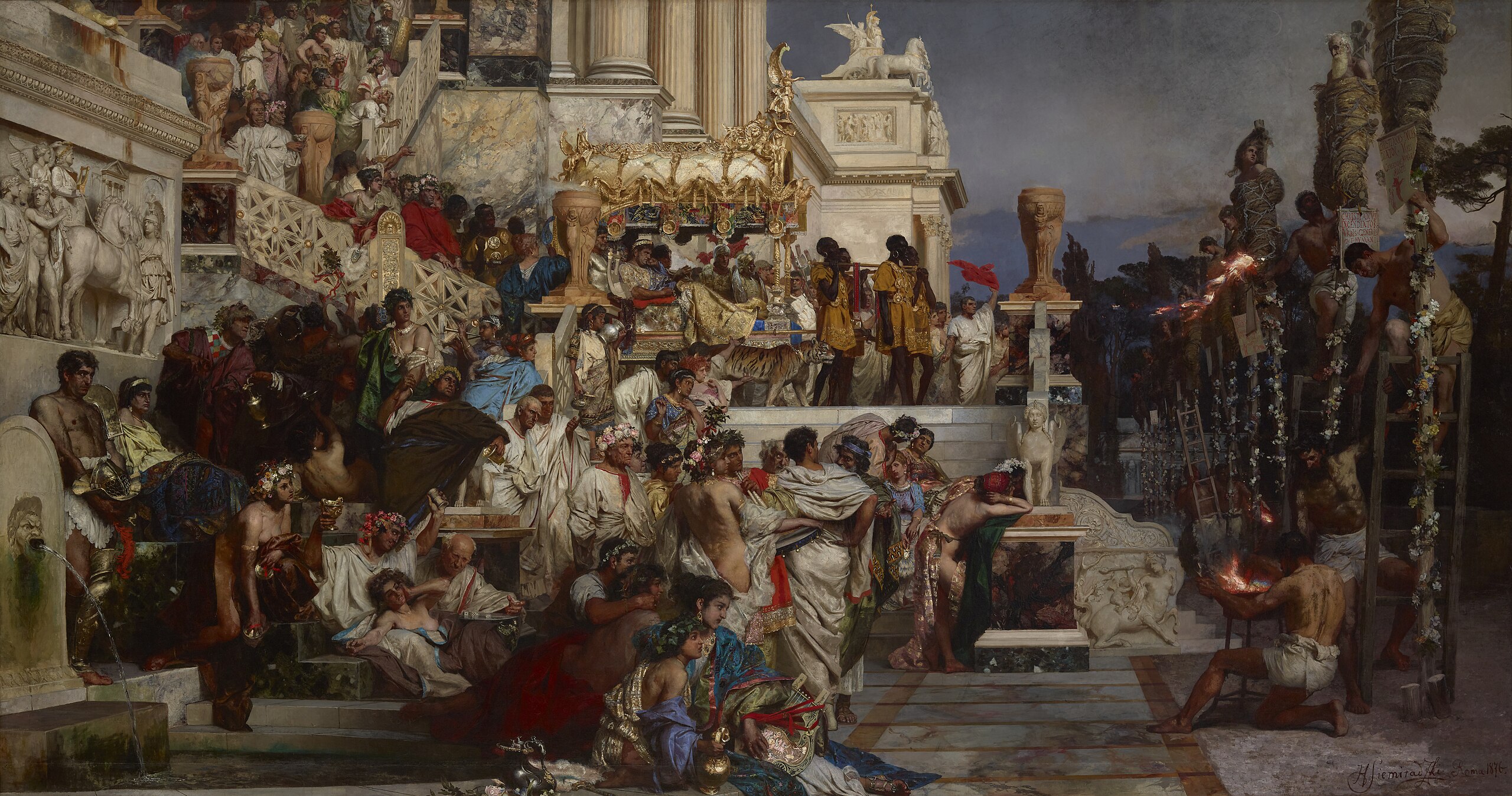
Christians were blamed for the fire, leading to the first mass persecutions in history against them—many were executed or sent to the gladiatorial arena. It was then that the apostles Peter and Paul met their martyrdom.
Repressions, the sidelining of Seneca, and the rise of Tigellinus and Poppaea increasingly turned the Senate against Nero. In 65 AD, a conspiracy arose led by Gaius Calpurnius Piso. Sometimes Seneca himself is included among the conspirators.
The conspiracy was uncovered due to a report by the freedman Milichus. Most of its participants were executed or committed suicide. Among the latter was Seneca, whom the emperor directly ordered to do so to avoid a public trial. The old philosopher cut his veins, but due to his age, the blood flowed slowly. Then he was given poison and placed in a hot bath, but even this did not hasten his death. Only after the former mentor of the princeps was moved to a steam room did he finally pass away.
Seneca met his death with stoic calm, comparing himself to Socrates. He went down in history as a positive figure and an exemplar of Roman virtues, but a careful reader might notice how the celebrated philosopher himself hastened his own end. It is doubtful that Seneca can be called a successful educator and teacher of morality, especially since he indulged his protégé in the murders of Britannicus and Agrippina to maintain political power. Seneca's financial dealings, which provoked an entire uprising in Britain, also cast a shadow on his image.
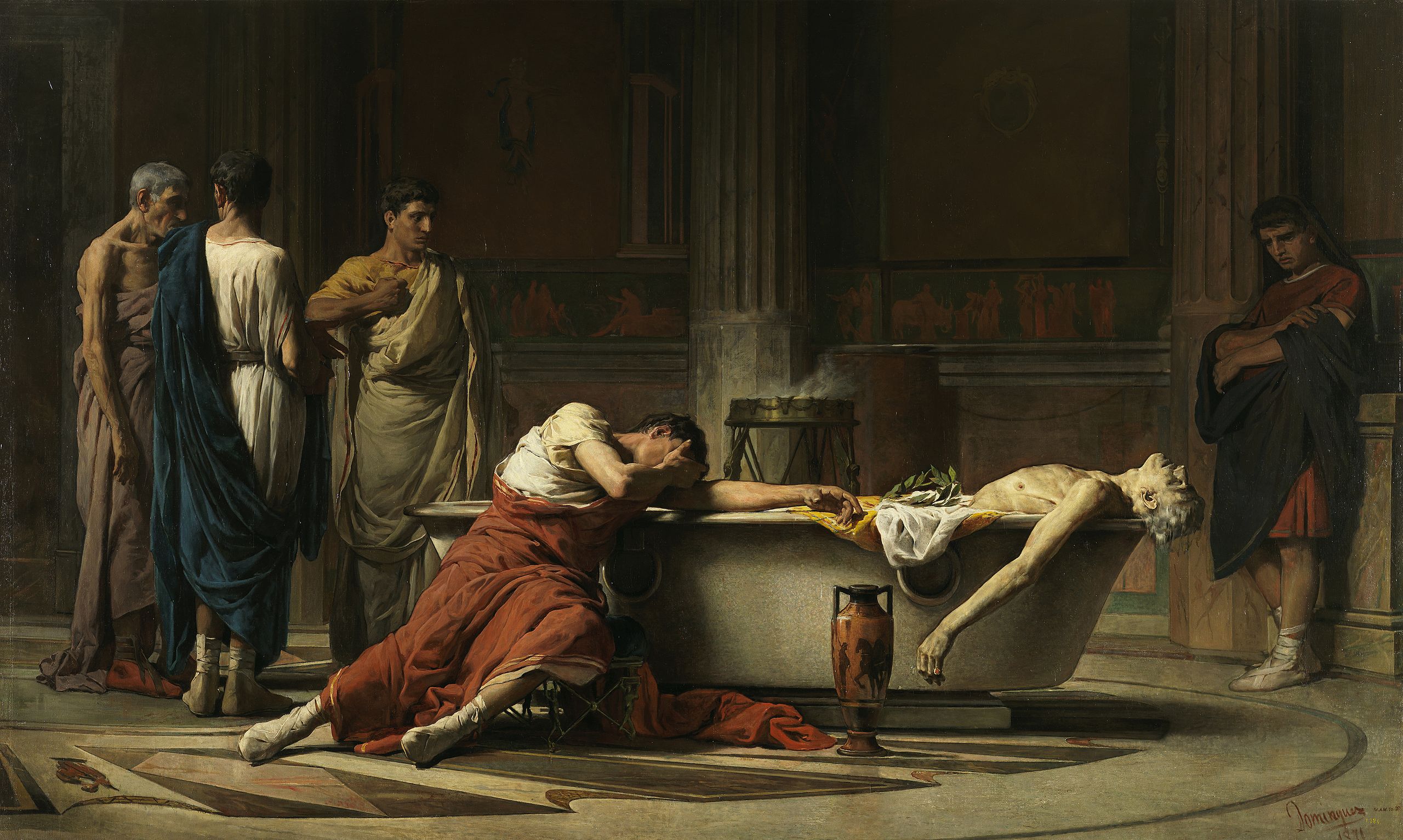
The leader of the senatorial opposition, Publius Clodius Thrasea Paetus, the author of "Satyricon" Petronius Arbiter, and the author of "Pharsalia" Marcus Annaeus Lucanus were also forced to commit suicide by opening their veins.
In 65 AD, Poppaea died – ancient authors claim that a drunken Nero beat his pregnant wife to death, although there are versions of a natural death. The emperor mourned his departed wife greatly, but soon married for the third time to Statilia Messalina.
"What an artist dies!"
In 67 AD, Nero went to Greece to participate in the Olympic Games, which were postponed for two years for him. There he ordered the execution of Corbulo, who had returned from the East and committed suicide. This turned the army against the emperor. At the same time, Nero learned of a new uprising, this time in Judea, and sent Titus Flavius Vespasian to suppress it – the future founder of the Flavian dynasty.
After winning at the Olympic Games, Nero triumphantly returned to Italy, but here he was informed that the governor of Lugdunensis Gaul, Gaius Julius Vindex, had raised a rebellion. Although Vindex himself was soon defeated, the baton of rebellion was taken up by the governor of Tarraconensis Spain, Servius Sulpicius Galba.
Galba's army was rapidly approaching Rome. Nero was planning to flee to the eastern provinces, which remained loyal to him, but at the decisive moment, the Senate, the Praetorians, and his closest associates, including his favorite Tigellinus, turned away from the emperor. In despair, Nero returned to the deserted palace, from which everyone had fled except the slaves.
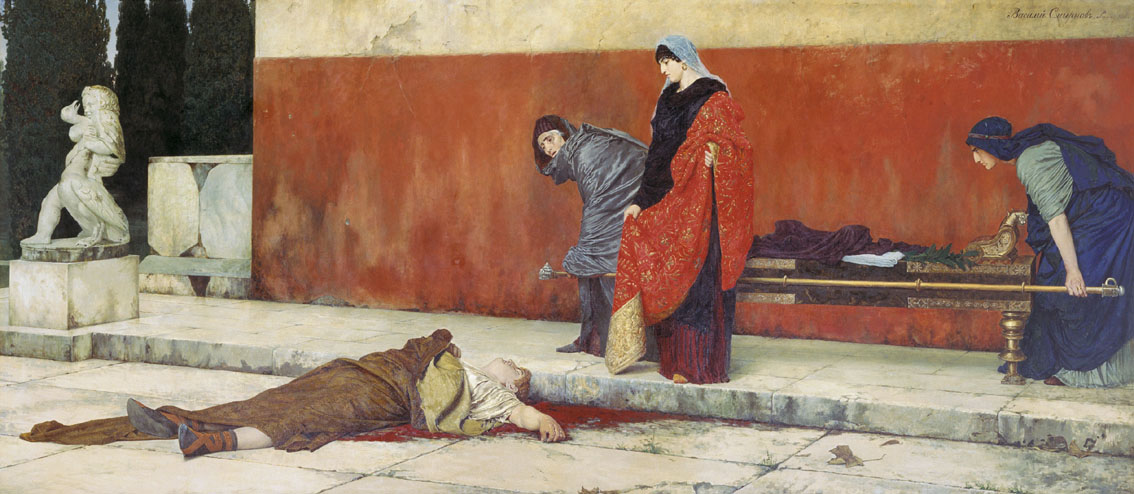
Accompanied by four servants, he reached a suburban villa, where after much hesitation, he stabbed himself with the words: "What an artist perishes!" At that moment, a detachment of horsemen sent by the Senate to arrest Nero, already declared a "public enemy," arrived at the villa. The emperor was still alive when one of the soldiers unsuccessfully tried to stop the bleeding. Misinterpreting the intentions of the horsemen, Nero said: "Here it is – loyalty", and died. He was 30 years old.
Afterlife
After Nero's death, a widespread belief emerged in the eastern provinces that the emperor had not perished but was hiding, waiting for the right moment to return to power. The persistence of this belief is clearly demonstrated by the fact that during the Flavian era, at least three impostors appeared, claiming to be Nero. This circumstance raises a legitimate question: if the emperor was such an odious tyrant, why did his name continue to serve as a banner for so long?
The explanation lies in the upheavals that followed Nero's death. The civil war in the "Year of the Four Emperors" (68 – 69 AD) shook Roman society, and against this backdrop, the 13 years of the previous reign became a symbol of lost stability.
Nero's repressions affected only a narrow circle of elite representatives and marginal sects, like Christians. In the eyes of the majority of the population, the emperor reduced taxes, rebuilt Rome after the fire, fought against the senatorial oligarchy, and protected the provinces from the greed of tax collectors and corrupt governors. Long after his death, flowers were still brought to Nero's grave. As the 2nd-century orator Dio Chrysostom noted, "Nero died, but not once and for all," and subsequent events turned out to be "less worthy." Talk of the emperor's return persisted until the 5th century.