History

Nikita Tsybikov
Historian
After winning the civil war, Octavian Augustus formally retained the republican institutions, but in fact took all the key magistracies under his personal control. He planned to pass them on to one of his close relatives, thereby laying the foundations of the monarchical principle.
One of Augustus's potential successors was his stepson Drusus the Elder – the brother of the future Emperor Tiberius, married to Antonia Minor, who in turn was the daughter of Mark Antony and Augustus's sister Octavia. Drusus proved himself a talented commander and administrator, but in 9 BC he died after falling from a horse.
His eldest son Germanicus inherited the best qualities of his father. After Augustus finally chose Tiberius as his successor and adopted him, Tiberius, at the insistence of the princeps, adopted Germanicus, thereby making his blood nephew his obvious heir.
From his marriage to Augustus's granddaughter Agrippina the Elder, Germanicus had nine children, but only six of them reached adulthood. The youngest of the surviving sons, born in 12 AD, was named after Gaius Julius Caesar. Thus, the boy was simultaneously the great-grandson of Octavian Augustus and Mark Antony, as well as the grandnephew of Tiberius.
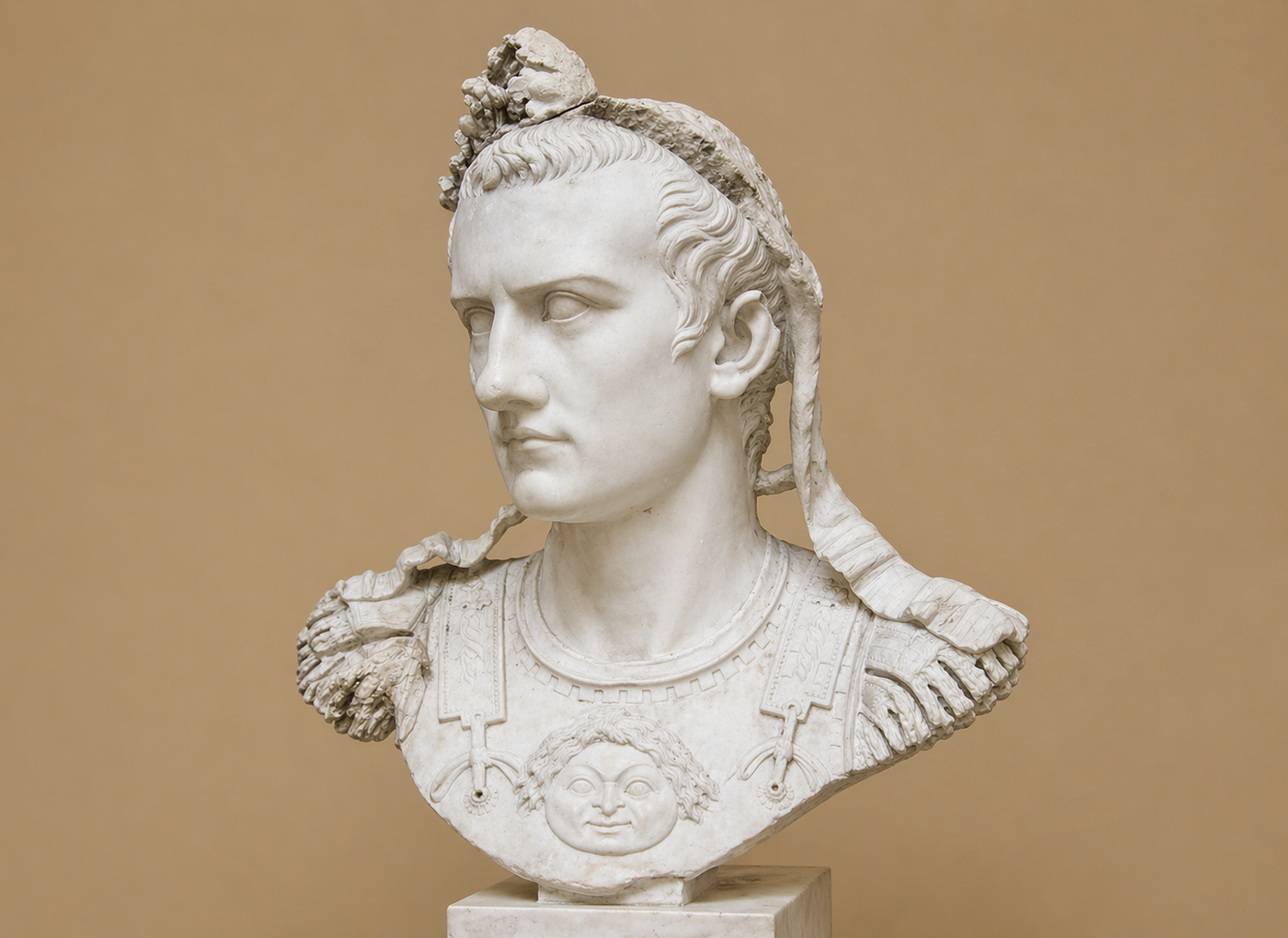
Germanicus became famous for his successful military campaigns in Germany, in which his family accompanied him. Once, his mother dressed the youngest son in children's armor with soldier's boots (caligae), after which the delighted legionaries began to call the son of their beloved commander "Caligula," meaning "Little Boot." Under this name, he would enter history.
Troubled Childhood
The first serious shock for the boy came in 14 AD, when after Augustus's death, Tiberius became the new princeps. At that time, some legions in Germany mutinied with the aim of proclaiming Germanicus as emperor. However, he did not wish to quarrel with his blood uncle and adoptive father, so he refrained from fighting and sent his family away from the military camp. In the absence of a leader, the mutiny subsided on its own.
In 18 AD, Caligula's father was sent with his family as the commander-in-chief of the troops in the eastern provinces of the Roman Empire. In Egypt, the locals attempted to deify the Germanicus sent to them, but he, like a virtuous republican, refused deification during his lifetime. Nevertheless, Caligula saw firsthand how power was perceived in the East.
Soon in 19 AD, Germanicus suddenly fell ill and died in Antioch. For 7-year-old Caligula, this was not only a personal but also a political tragedy. His family found itself in the whirlpool of court intrigues.
Dangerous Youth
Around Germanicus's widow Agrippina the Elder and their sons, an influential political group formed. The mother consistently promoted the candidacies of Nero, Drusus, and Caligula as legitimate heirs, using the growing unpopularity of the stingy emperor who had abandoned state affairs and retired to the island of Capri. An ally of this "party" was also Livia – Augustus's widow, Tiberius's and Drusus the Elder's mother, Germanicus's grandmother, and thus Caligula's great-grandmother.
The opposition to the "party of Germanicus" consisted of supporters of Drusus the Younger – Tiberius's biological son. However, Drusus suddenly died in 23 AD, after which his widow Livilla began to promote their son Tiberius Gemellus as heir. An ally of this "party" was the ambitious prefect of the praetorian guard – Lucius Aelius Sejanus, who concentrated more and more power in his hands as the emperor withdrew from affairs.
In 29 AD, Livia died, after which Sejanus managed to obtain Tiberius's permission to arrest Agrippina and her elder sons. Only the young Caligula escaped repression, being sheltered and protected by his grandmother Antonia Minor – the daughter of Mark Antony and Augustus's niece, the widow of Drusus the Elder, the mother of Germanicus... and Livilla.
Antonia Minor, as the daughter of Mark Antony – a famous lover of the East – created an atmosphere of an eastern court, supported by young eastern aristocrats sent to Rome as honorary hostages. In their company, Caligula once again appreciated how power was represented in the East.
In 31 AD, Tiberius, with the help of Antonia Minor, uncovered Sejanus's conspiracy, after which the all-powerful prefect of the praetorian guard was executed, and Livilla, accused of poisoning her husband Drusus the Younger, was sent to her mother's house, where legend has it that Antonia starved her daughter to death.
The defeat of the "party of Drusus the Younger" did not mean the rehabilitation of the "party of Germanicus." Caligula's mother Agrippina the Elder and his elder brothers – Nero and Drusus – remained in captivity, where they soon died of starvation.
Apparently, Tiberius decided to raise an heir "in his own image," and chose Caligula for this role, who was transferred to the emperor on Capri. Alongside training in military affairs and state administration, he also learned the lifestyle of the old princeps in the form of orgies and drunkenness. Among other things, Caligula with "great pleasure danced and sang on stage", which seemed unthinkable for a noble Roman of the republican era.
Theoretically, Caligula's co-ruler was supposed to be Tiberius Gemellus – the son of Drusus the Younger and Livilla. Ideally, this would reconcile the "parties" of Germanicus and Drusus the Younger. However, the potential co-ruler was seven years younger, and Caligula acquired an influential ally in the form of the new prefect of the praetorian guard Quintus Macro, who even "offered" his own wife Ennia to the heir to strengthen the alliance.
In March 37 AD, 77-year-old Tiberius died. Macro, as the commander of the praetorian guard, in violation of the deceased's will regarding co-rulership, ensured the immediate transfer of power in favor of only one princeps – 25-year-old Caligula. 18-year-old Tiberius Gemellus was formally adopted by the new emperor and declared heir.
A Wonderful Beginning
Rome rejoiced, for the princeps became the son of the beloved Germanicus, whose family was considered the embodiment of old republican virtues. Suetonius eloquently conveys the public enthusiasm: “The public rejoicing was such that in the next three incomplete months, it is said, more than one hundred and sixty thousand sacrificial animals were slaughtered.”
Augustus came to power as a victor in the civil war and a pacifier of the “restored republic.” By the time Tiberius was proclaimed princeps, he was already a distinguished military leader and administrator. The merit of the young Caligula lay only in the fact that he was from the “right” dynasty—a curious detail in the history of the transition from republican orders to monarchical ones.
The frugal Tiberius left his heir a substantial treasury, and he began his reign with generous spending: each Roman citizen received 150 sesterces, lavish spectacles, feasts, bread distributions, and large-scale construction resumed.
Caligula normalized relations with the Senate. All trials from Tiberius's time regarding offenses against majesty were halted, and both the surviving and deceased were rehabilitated, including the new emperor's mother and brothers. Caligula declared that henceforth “his ear is closed to informers” and restored the practice of public reports for magistrates. In modern terms, a political “thaw” occurred in Rome.
However, by the fall of 37 AD, Caligula fell ill. The nature of the illness remained unclear, but there were rumors of poisoning. Most Romans sincerely hoped for the recovery of their beloved princeps. And he did recover, but seemed to become a different person. “Until now, we spoke of a ruler, henceforth we must speak of a monster,” described Suetonius of the sudden change.
Disappointment
The princeps “celebrated” his recovery with sudden executions. The first to fall was the heir Gemellus, who, to be fair, would always remain a focal point for any opposition.
Caligula did not spare his former father-in-law either—the influential senator Marcus Junius Silanus, the father of his first wife, who died before he became emperor.
The turn also came for Macro, who, along with his wife, was forced to commit suicide by the emperor's order, fearing the emergence of a “second” Sejanus. To weaken the influence of the commander of the Praetorian Guard, Caligula restored the collegiality of this position by appointing two prefects at once, as was practiced before Tiberius.
The “thaw” in relations with the Senate ended. Suetonius and Cassius Dio relay the famous story of the horse Incitatus, whom Caligula intended to make consul. Often this story is presented as evidence of madness and infantilism. However, it can also be interpreted as a demonstration of the new power hierarchy, in which the emperor, as an autocratic monarch, could do anything regarding the old republican institutions. Cassius claims that the princeps even threatened to make the horse consul as a complete humiliation of the senators. So, it is, of course, about despotism, but not madness.
Instead of the Senate, Caligula began to rely on the support of the equestrian order and the urban plebs. In 38 AD, the emperor took away from the Senate the right to elect magistrates and transferred it to the popular assembly, although this practice lasted only two years, after which there was a rollback. The plebs were also bribed with “bread and circuses”—it was under Caligula that this classical formula came to life.
As if making up for all the years spent in fear under Tiberius, Caligula now demonstratively indulged in luxury, which sharply contrasted with the behavior of previous princeps. To the indignation of the old republicans, the emperor replied: “One must live either as a modest man or as a Caesar!”
Such extravagant policies required colossal funds. Caligula abolished the tax farming system and introduced new taxes, both direct and indirect. The revived trials for offenses against majesty also became a tool for replenishing the budget through confiscations of property from disloyal citizens.
The emperor did not forget the impressions from the East and those who came from there. To his friends raised with Antonia Minor, he gifted the Roman provinces of Judea, Commagene, Lesser Armenia, Pontus, and Thrace. To be fair, in those same years, he annexed Mauretania and killed its last king.
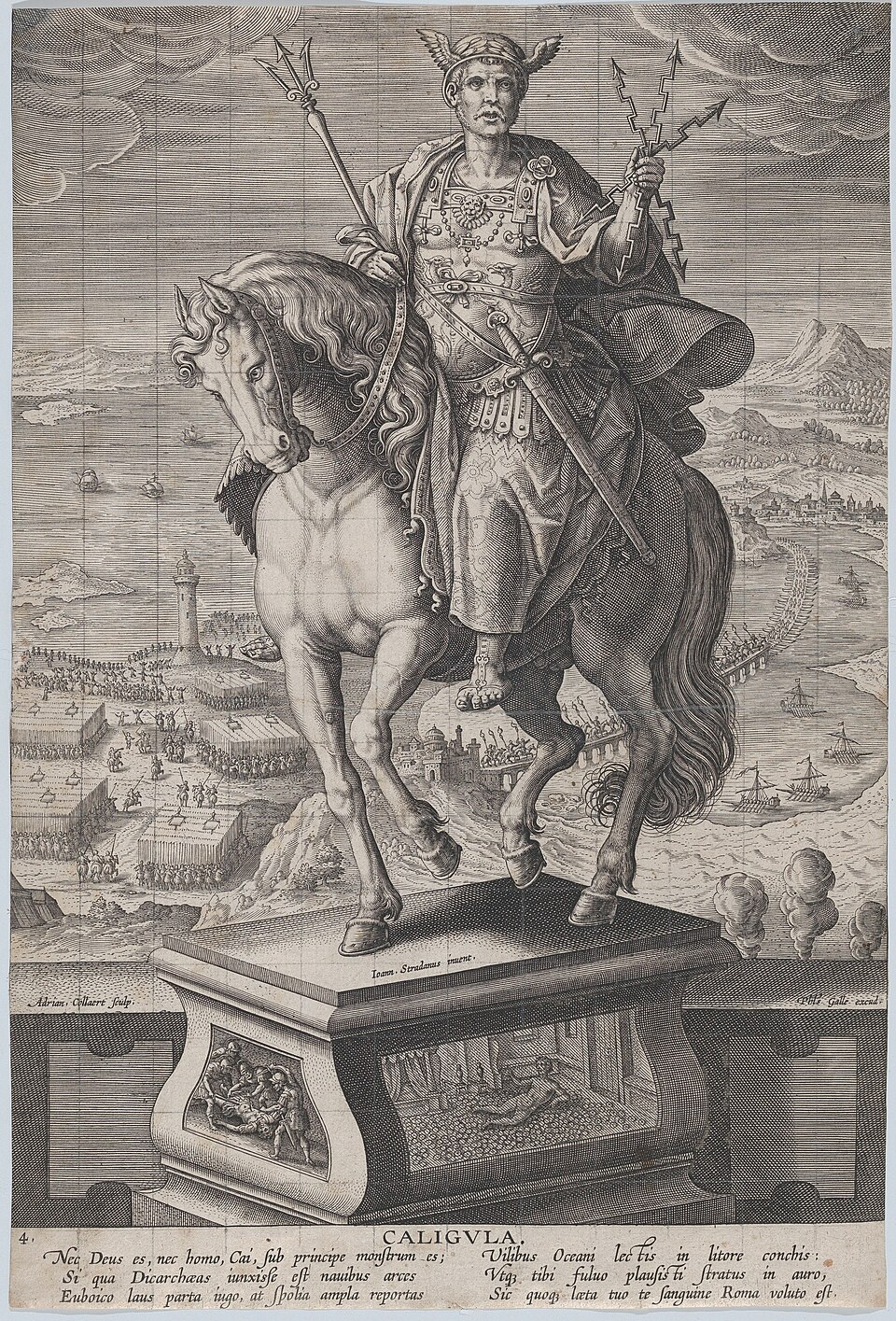
Like the Hellenistic monarchs of the East, Caligula, contrary to all republican traditions, deified himself during his lifetime as the embodiment of the god Jupiter. For comparison, Caesar or Augustus were deified only after death, but not during their lifetime.
Thus, by his unwillingness to at least imitate traditional republican virtues and his ostentatious display of Eastern despotism, Caligula alienated the Roman elite.
In 39 AD, a conspiracy against the emperor matured, involving his friend, the official heir, the husband of his beloved but early deceased sister Drusilla, consul Marcus Aemilius Lepidus, the commander of the Upper German legions Gnaeus Lentulus Gaetulicus, as well as the emperor's two other sisters—Agrippina and Livilla. Learning of the conspiracy in time, Caligula personally went to the Rhine legions, where he exposed and executed Gaetulicus. Lepidus was also executed, and the imperial sisters were sent into exile.
The years 39–40 AD were dedicated by the princeps to organizing campaigns against the Germans beyond the Rhine, trying to repeat his father's successes. Although the scale of the campaigns was modest, they indeed achieved local successes. Caligula also planned a full-scale invasion of Britain but abandoned it due to the unstable situation within the empire.
And there was much to fear. A new conspiracy followed the exposed one, which the emperor did not manage to uncover. The decisive role was now played by the military tribunes of the Praetorian Guard Cassius Chaerea and Cornelius Sabinus, with the support of senators.
On January 24, 41 AD, the emperor was leaving the theater, where the Palatine Games were then taking place, together with his fourth wife Caesonia and his only legitimate child, the 11-month-old Julia Drusilla, named after his beloved deceased sister. The conspirators attacked and killed all three.
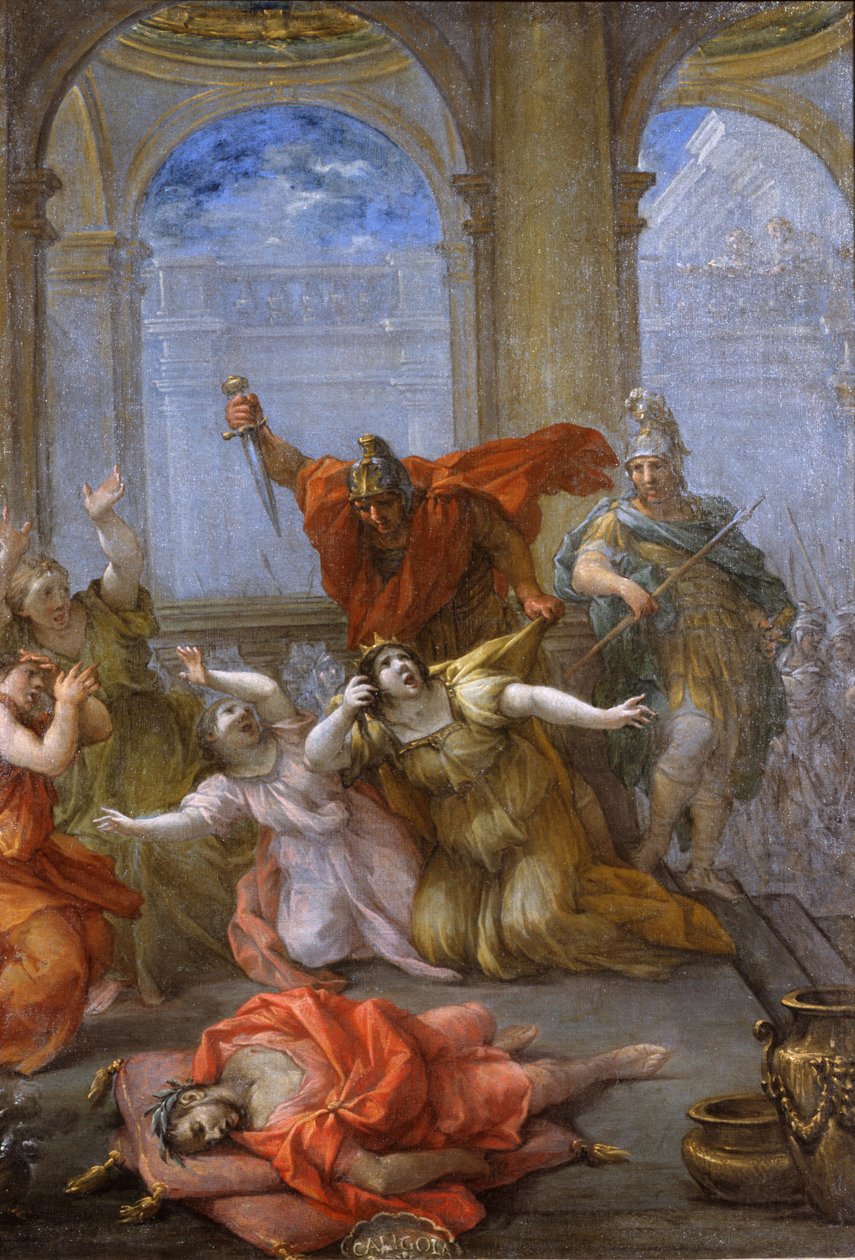
Immediately after the emperor's assassination, the senators attempted to restore republican rule, but found no support from the plebs, the legions, or the Praetorians. As a result, the latter proclaimed Claudius as the new princeps – the son of Drusus the Elder and Antonia the Younger, brother of Germanicus, and thus the uncle of Caligula.
Ancient authors, representatives of the elite strata of society, unanimously condemned Caligula and portrayed him almost as a madman. Not a single apologetic work about the emperor or even mentions of such have survived to us.
At the same time, modern historiography tends to view Caligula with greater understanding of his motives. A childhood and youth full of conspiracies and intrigues, constant fear for his own life, and the death of all his relatives evidently affected the character of the future emperor. Upon becoming princeps, he began to demonstrate his autocracy in an eccentric manner in the style of an eastern monarch, which the Roman elite could never forgive him. Only two centuries later did Diocletian finally overcome the remnants of republicanism and successfully implement the system of the Dominate, in which the ruler would officially be called "lord and god."