Political science

Pavel Dubravsky
Political Consultant, author of the Telegram channel "Campaign Insider"
Following the 2016 election, Donald Trump became the 45th President of the United States. This fact greatly upset some people, while others were delighted. From the first month of the new presidency, American society was divided into those who hated him and those who forgave all his mistakes. In between, there was a layer of undecided voters on whom it depended whether to give Trump a second chance in the 2020 re-election.
Against All Odds
"Do not be afraid to make mistakes."
Donald Trump
There are two key books about Trump from the 2016-2020 period. The first is "Fire and Fury in the White House" by Michael Wolff. The second is "Fear: Trump in the White House." Both books are extremely biased against Trump and cannot even be considered an attempt to objectively describe the work of the Trump administration.
The first book is entirely based on... the absence of sources. Wolff promised to provide his recordings and conversations with White House informants, but when cornered, he refused to do so. Believing everything written in this book is dangerous. A vivid example is the hint of an affair between Trump and Nikki Haley, his opponent in the 2024 primaries.
The second book was penned by the legendary journalist Bob Woodward. The same one who investigated "Watergate" at the The Washington Post and wrote a book about it. Among supporters of the Democratic Party, his word is law, but we will approach this work more critically.
Despite the author's merits and achievements, his book contains too many moments of overt bias against Trump. This is evidenced by an episode where Woodward refers to a witness of a dialogue between the Republican candidate and his strategist Stephen Bannon, where Bannon literally tells Trump what to do during the campaign, and the candidate agrees.
Woodward presents this as if Trump is a puppet and Bannon is his commander. In fact, any political consultant in any country in the world will confirm that a campaign manager or political strategist always tells their candidate what to do in elections, as they are paid for it. And there are too many such moments to ignore (I counted just over 50 per book).
In one thing both authors are absolutely right, the administration of Trump's first term was chaos — 92% of his team changed by 2021.
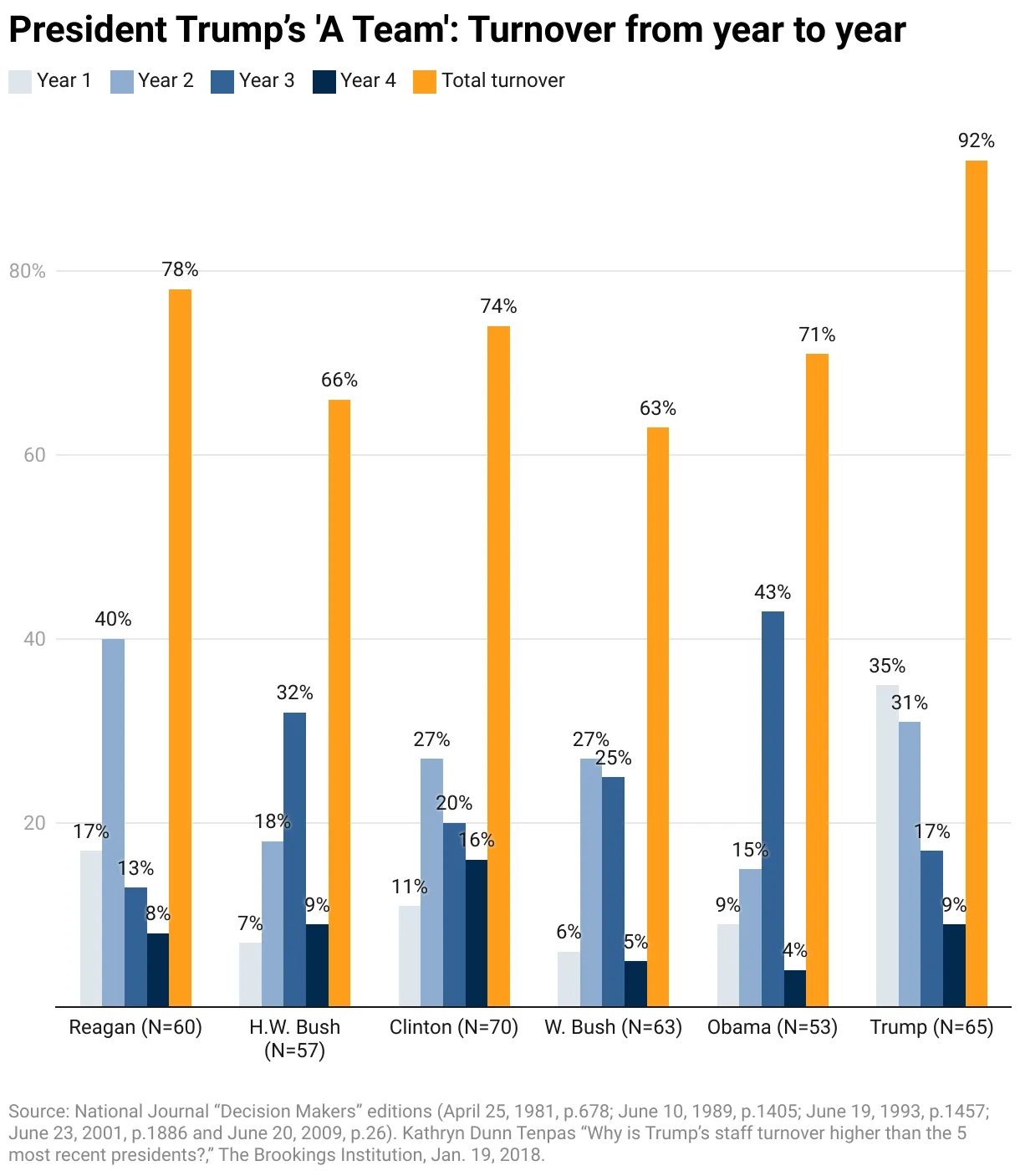
Trump literally searched for officials for his administration through acquaintances, friends, and golf players he interacted with. The lack of a team and plan greatly affected the overall perception of the first presidency.
His approval rating in January 2017 was 45%. By the end of the year, it would drop to 35% approval. This is the lowest "honeymoon" among American presidents of the 20th and 21st centuries, even Biden had 57%.
"Honeymoon" — the first month of the presidency when the politician's ratings are usually the highest. Voters have not yet faced painful decisions, so they view him more favorably than during the rest of the term.
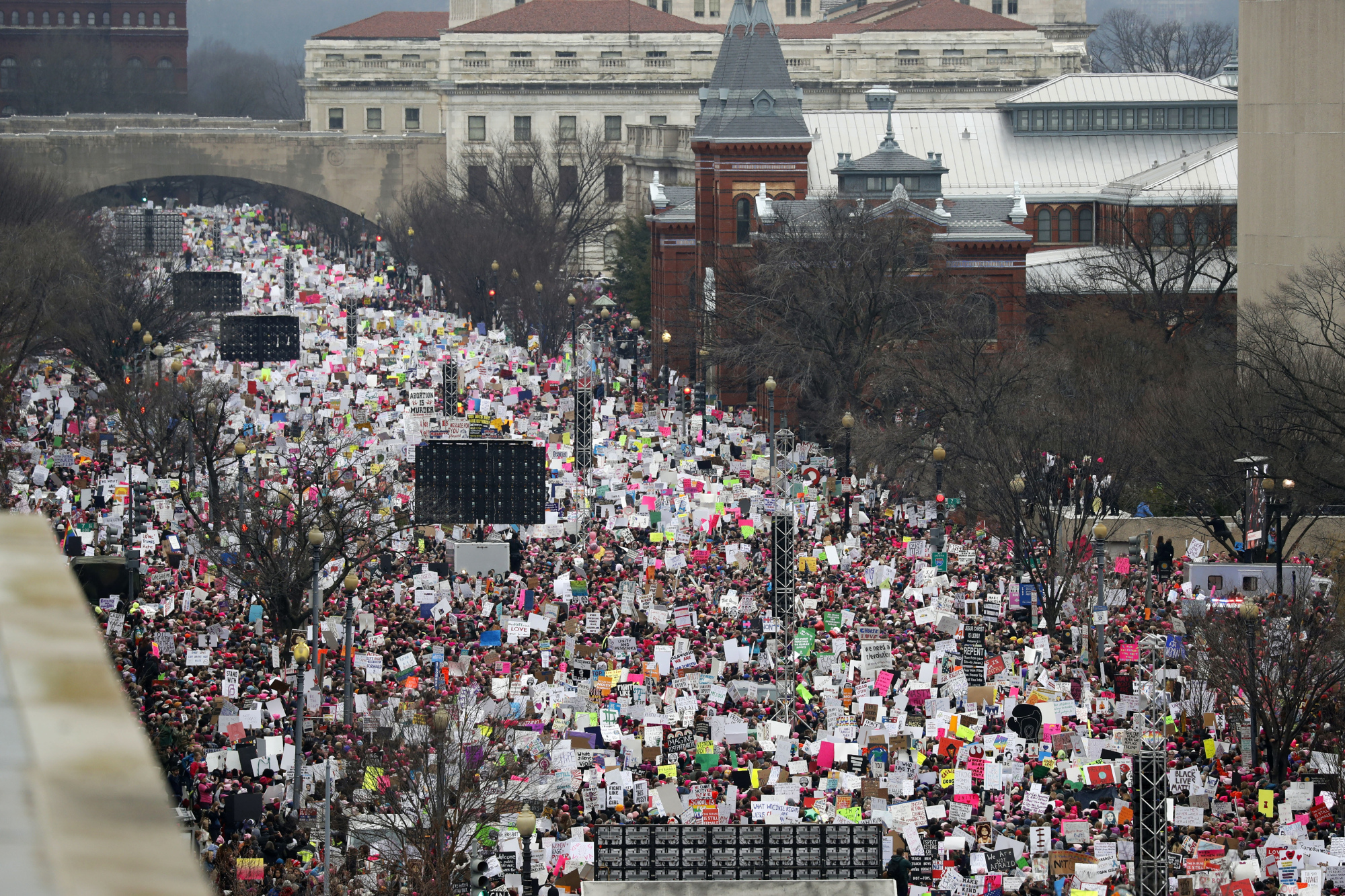
Not only the rating signaled that American society was reacting to the "Trump virus." Thousands of crowds united in different cities against the president under the banner of the "Women's March." It was the largest single-day protest in U.S. history, which according to various estimates involved from 3 to 5 million participants. The most interesting thing is the date it happened — January 21, the day after Trump's inauguration.
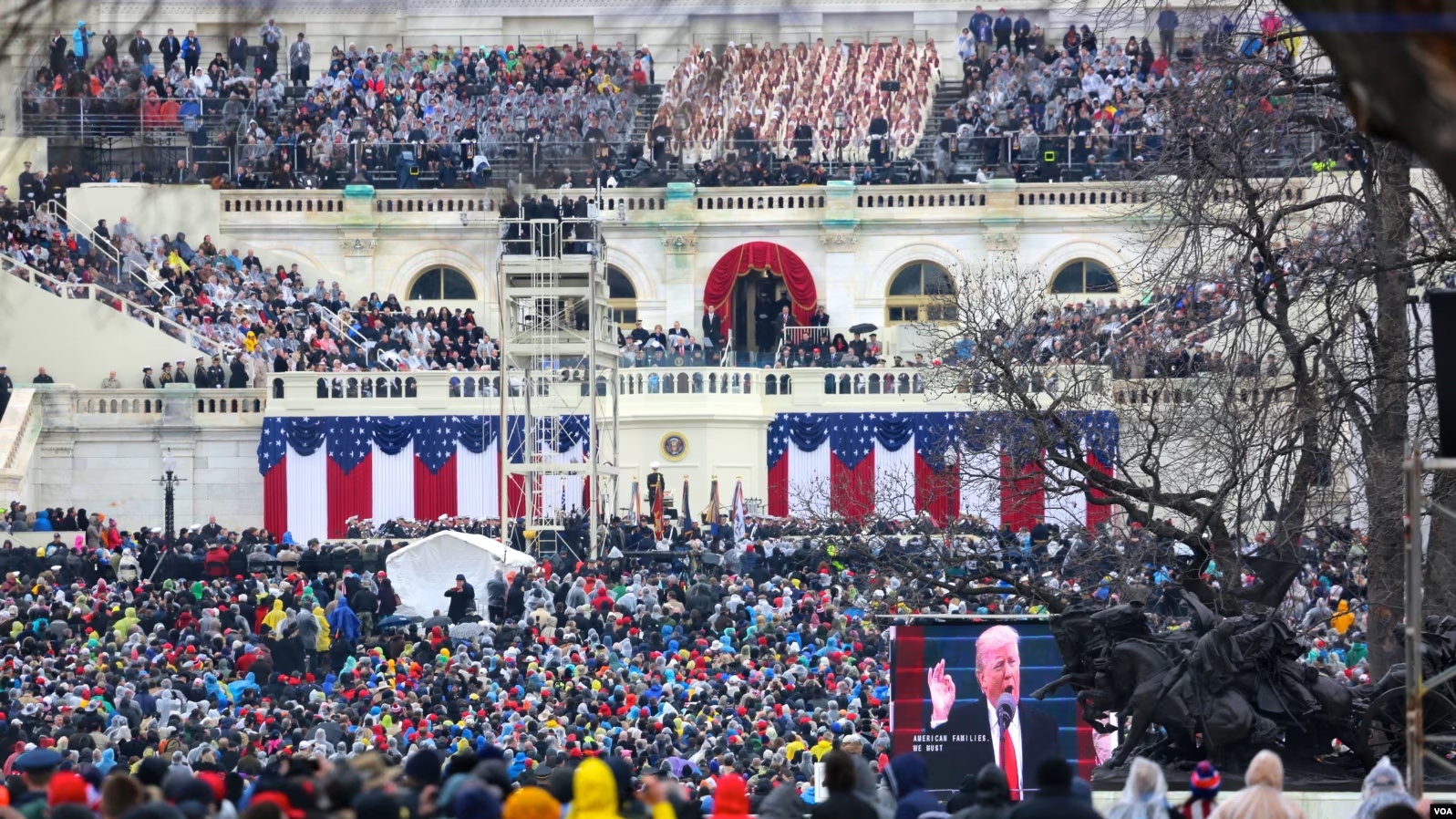
Thus symbolically began Trump's rule. In those days, we saw two different countries: one America — celebrating victory, the other — protesting.
First term
We focus primarily on Trump's election campaigns because describing his entire political history would require writing a separate book. But without summarizing his presidency, it's difficult to understand why he lost in 2020.
Evaluating a politician's decisions is always challenging. It's very easy to fall into "like/dislike" and give personal opinions instead of analysis. Therefore, we will try to briefly highlight the main outcomes of Trump's first term without delving into deep discussions about the consequences of each decision.
To remain as neutral as possible, we will divide the outcomes into "achievements" and "controversial" decisions. The former includes what Trump promised his electorate and what fits into his 2016 campaign platform. This is a very important criterion because appointing 3 conservative Supreme Court judges is a plus for Republicans and a minus for Democrats.
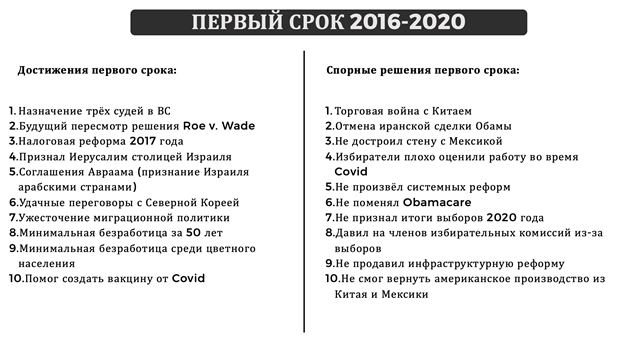
In domestic policy, it is worth noting the significant strengthening of the judiciary with three representatives of conservative thought. This decision will later earn Trump political points during the 2024 campaign when the Supreme Court makes a historic decision in the case of Roe v. Wade.
In June 2022, in the case of "Dobbs v. Jackson Women's Health Organization," the U.S. Supreme Court ruled that the Constitution does not provide a right to abortion, and states have the right to regulate this area independently, according to the 10th Amendment to the Constitution, and overturned the decision in Roe v. Wade, as it directly contradicted the 10th Amendment.
Trump implemented a tax reform which, according to him, reduced tax expenses for American families by several thousand dollars a year. At the same time, all experts agree that the reform reduced the tax burden for the wealthiest Americans. Corporate taxes were reduced from 35% to 21%.
There are two opposing positions here. On one hand, it became easier for the rich, while the poor and middle class were barely affected by this reform. On the other hand, companies usually invest tax-free funds in production, product improvement, and job creation.
Trump, as promised, tightened immigration policy. During his first term, he deported nearly 1 million illegal migrants. However, the president was unable to reform the immigration system and did not complete the wall with Mexico as promised.
Trump's main achievement was the economy. Unemployment fell to a record 3.5% in the last 50 years. In 2018, GDP growth was 2.9% — the highest since 2015. Stock indices S&P and Dow Jones set several growth records. The Trump administration claimed that for every new economic regulation, they repealed 8 previous ones.
However, the weakest topics in terms of achievements were healthcare, which Trump did not reform, and the unrealized infrastructure reform. The latter proposed allocating funds for updating state infrastructure, such as bridges, roads, and more. It was later implemented under Joe Biden.
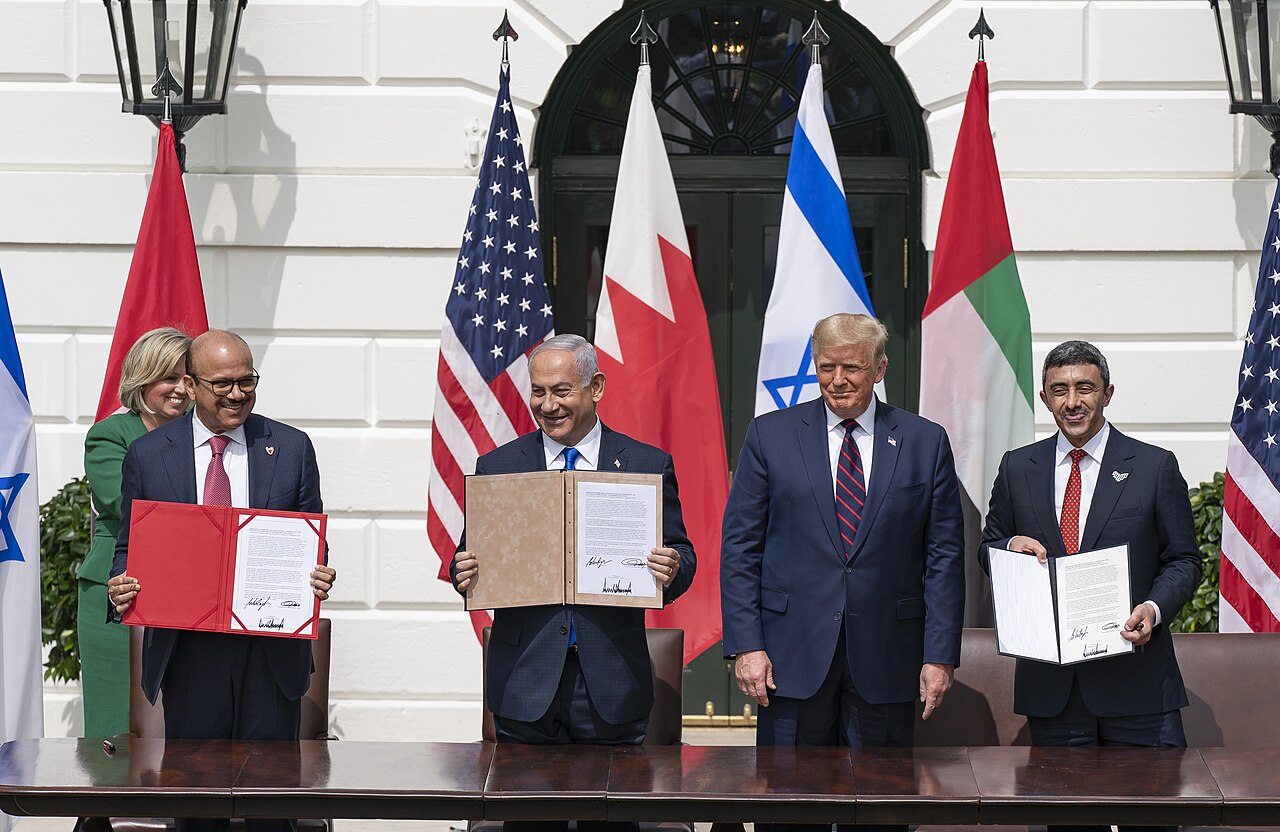
In foreign policy, Trump had more unequivocal achievements. He pursued a pro-Israel policy, which may not please his opponents but aligns with his promises. The Republican managed to sign the Abraham Accords recognizing Israel by the United Arab Emirates and Bahrain, with the prospect of extending the agreement to other countries in the region, such as Saudi Arabia.
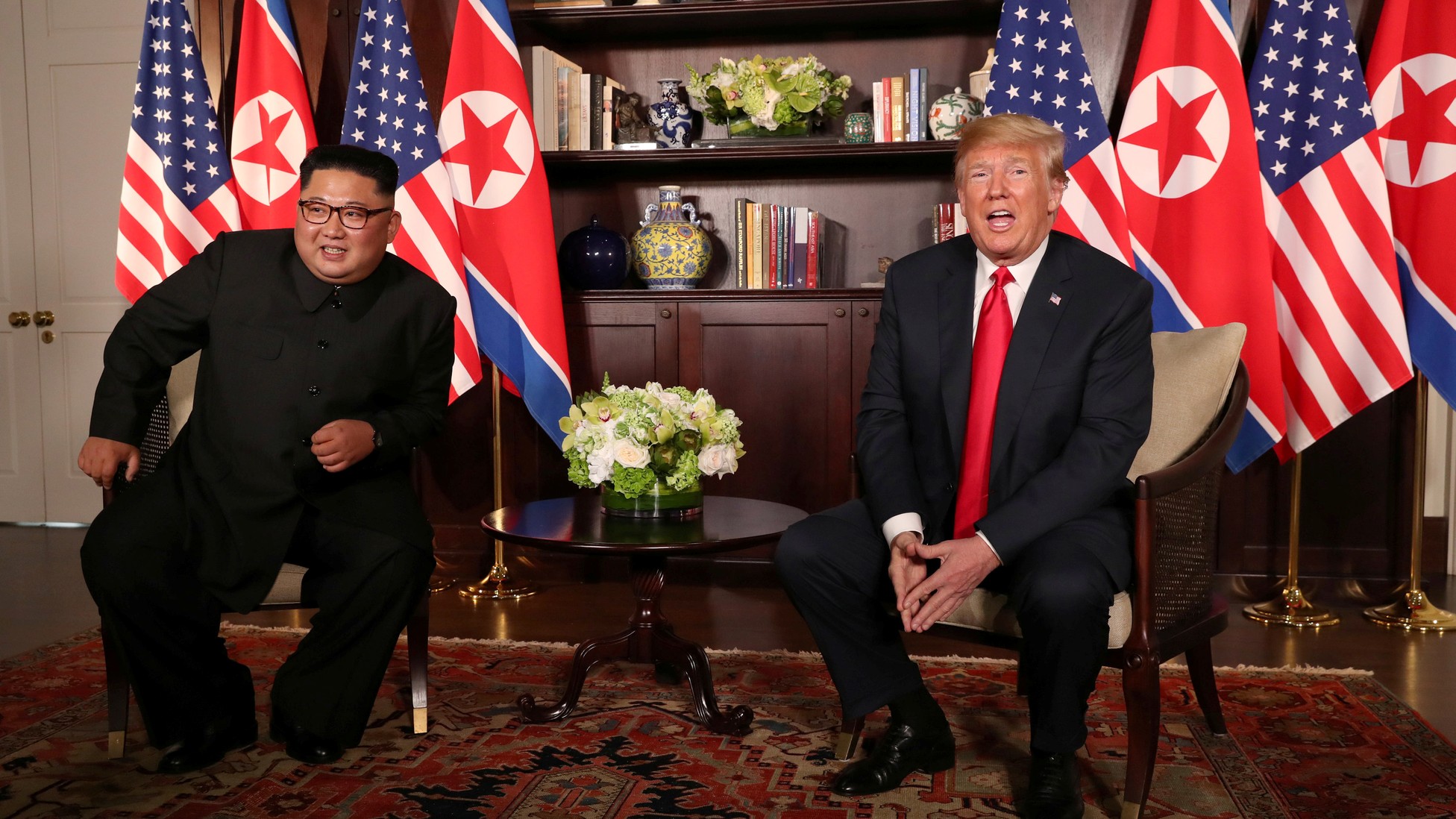
Trump also "reassured" the leader of North Korea. During the 2024 campaign, we learned how it happened. Somewhat comically, the leaders were literally comparing the size of the red buttons on their desks for launching missiles. In the end, the increased threats from North Korea remained just threats.
A trade war with China was unleashed. I note that the anti-China discourse is a compromise solution of both parties, but Trump immediately implemented this idea. Since 2018, the parties have been imposing tariffs on each other, but the US started first.
The President canceled the "Iran deal," which was developed under Barack Obama. Trump considered it too lenient, although by 2025 he will propose a nearly similar deal and ask Russia for help in negotiations with Tehran.
The Iran deal — international control over Iran in nuclear energy issues with a ban on military use in exchange for lifting sanctions. Peaceful use was allowed.
There was also an international scandal, which ended with an attempt to bring the first impeachment. Trump allegedly pressured Ukrainian President Volodymyr Zelensky in July 2019 to start an investigation against Joe Biden and his son Hunter. It was claimed that the president withheld $391 million in military aid to Ukraine and invited Zelensky to the White House to secure a politically advantageous investigation. This was seen as an abuse of power and interference in the US internal elections.
The House of Representatives (with a Democratic majority) announced impeachment on December 18, 2019, on two articles:
Abuse of power;
Obstruction of Congress.
The Senate (where the majority are Republicans) acquitted Trump on February 5, 2020.
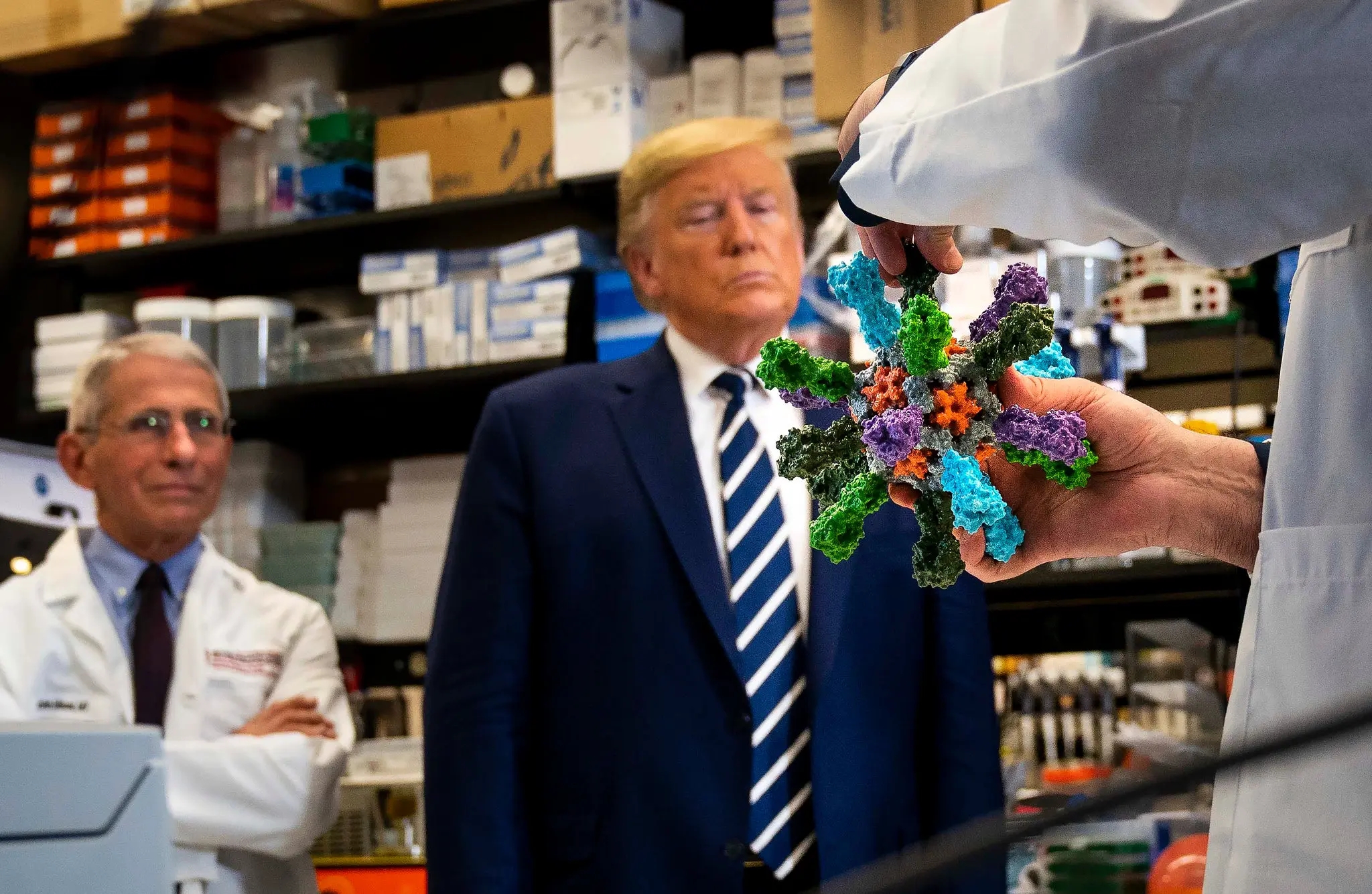
There can be much debate about Trump's achievements and failures during his first term, but one thing remains a fact — Covid-19 became his Achilles' heel.
Trump's Main Enemy
"When the US sneezes, the whole world catches a cold."
Donald Trump
As is typical of an election campaign, it begins when the previous one ends. As early as 2019, Trump was actively campaigning for himself. It was clear that he would run for re-election, and he had no significant competitors. Trump was already preparing a new campaign slogan — "Keep America Great Again" (Keep America Great Again).
The main platform for re-election was supposed to be the economy, but everything began to change in December 2019 when frightening news started coming from China. The pandemic, lockdowns, and Covid forever changed not only our lives but also the fate of Donald Trump.
According to statistics, in the 20th century, 7 out of 13 presidents or 54% were re-elected for a second term. If we consider all presidents, out of 30 presidents who ran for a second term, 19 managed to do so. The numbers were in Trump's favor. But it didn't happen. Why?
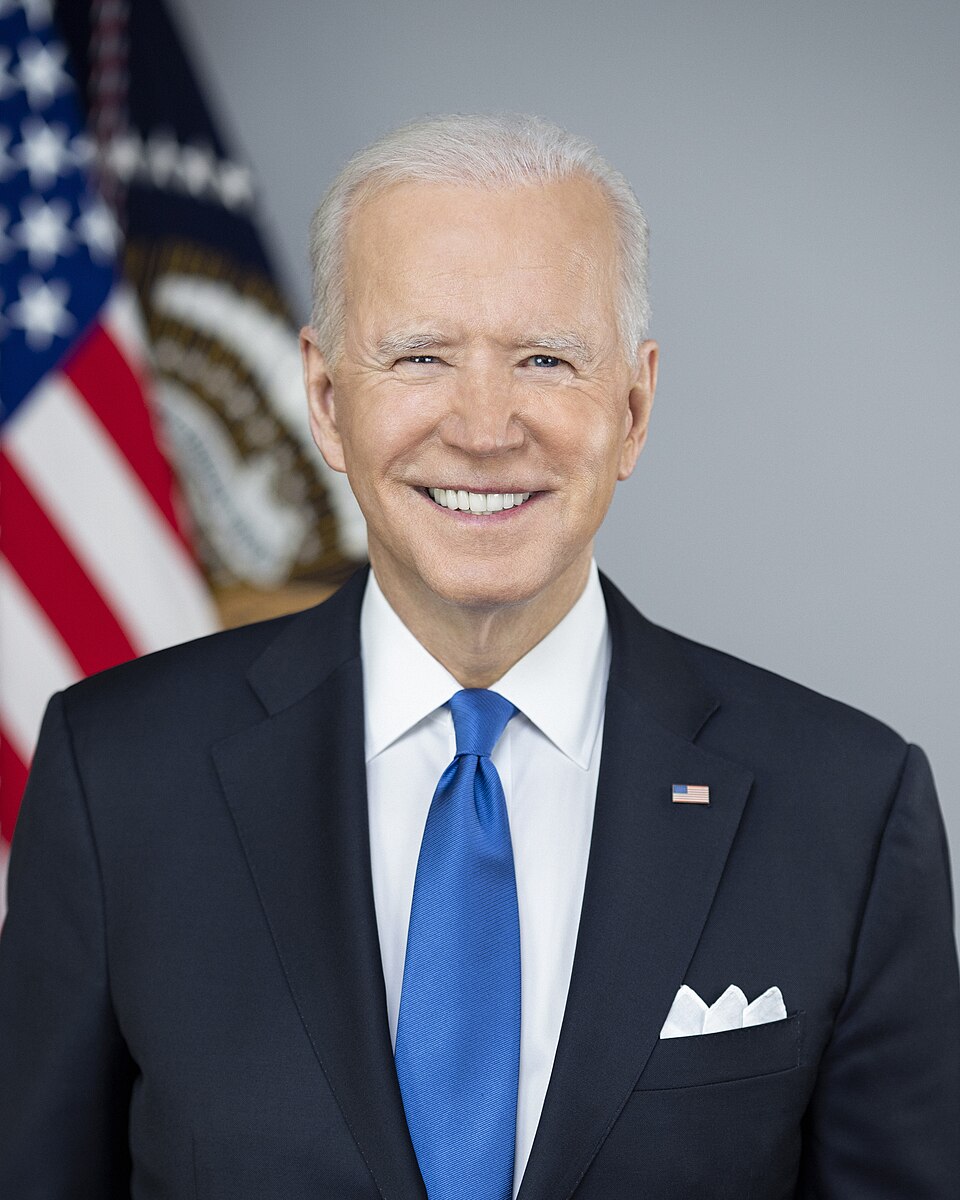
Trump ran against Joe Biden, who by 2020 had run for president three times but hadn't even reached the primaries — the preliminary elections within the party. He was a consensus figure among Democrats, as the alternative could have been socialist Bernie Sanders, whom the party elite feared for his radical views. After the first primaries, Sanders was winning in several states, but later under party pressure, he withdrew his candidacy.
It cannot be said that Biden's rating was high, but it was higher than Trump's — about 50%. Most polls predicted his victory by 4-7%. American sociology once again let voters down, but more on that later.
Trump's main enemy was not even Biden, and certainly not Sanders. Like many in 2020, Trump was brought down by COVID-19. The US set a record for the number of infections and deaths — more than 1 million deaths from the virus. Throughout the election year, all social networks, TV, and newspapers showed only one picture — fear of the invisible disease and those who fell from it. Under such conditions, the campaign between presidential candidates was not built around their ideas but posed the question — how to save the lives and economy of the country?
The fact is, there were two options for dealing with COVID. The Swedish option of refusing lockdowns and quarantines to preserve the economy and jobs. And the total closure of the entire economy, schools, kindergartens, and public places. Trump removed himself from deciding this issue in the first few months, and later allowed states to decide for themselves how to proceed. Most chose the second option.
The 2020 elections were dedicated to the question of saving America from the pandemic. Biden embodied lockdowns, the suspension of the economy, and working with all the World Health Organization's guidelines. Trump thought otherwise, but he could not convey a clear message to the voters. It turned out that the most important "Rust Belt" states felt the blow more than others, but the president did not help them in any way. These are the very voters who voted for Trump for jobs and economic recovery, but in 2020 felt abandoned.
The rhetoric of the Republican Party, which discouraged its voters from using absentee voting methods like mail-in voting, also had an impact. In the pandemic conditions, this was a shot in the foot. In 2016, 40.8% of voters voted early, and in 2020, 64% of voters — 100,000,000 people.
And so Donald Trump survived an impeachment attempt, simultaneously dealing with a pandemic and people dying, while needing to run a campaign. The media blamed only him, his ratings held, but the swing states gave contradictory numbers. Trump met Biden in debates and all the pressure he was experiencing erupted in a very aggressive form.
Trump constantly interrupted Biden, not letting him speak, showing his emotionality. At one point, Biden couldn't stand it and suggested his opponent shut up. Among the surveyed voters, this moment became one of the most memorable. Biden behaved like a president, and Trump like a showman, but at a very inopportune time. When voters wanted a crisis manager and a strong leader, they faced a grumpy and vindictive Trump, who paid more attention to his opponent than to the problems of Americans.
Judgment night came and... Trump devastatingly lost to his opponent. He lost important swing states and received significantly fewer votes in the national vote.
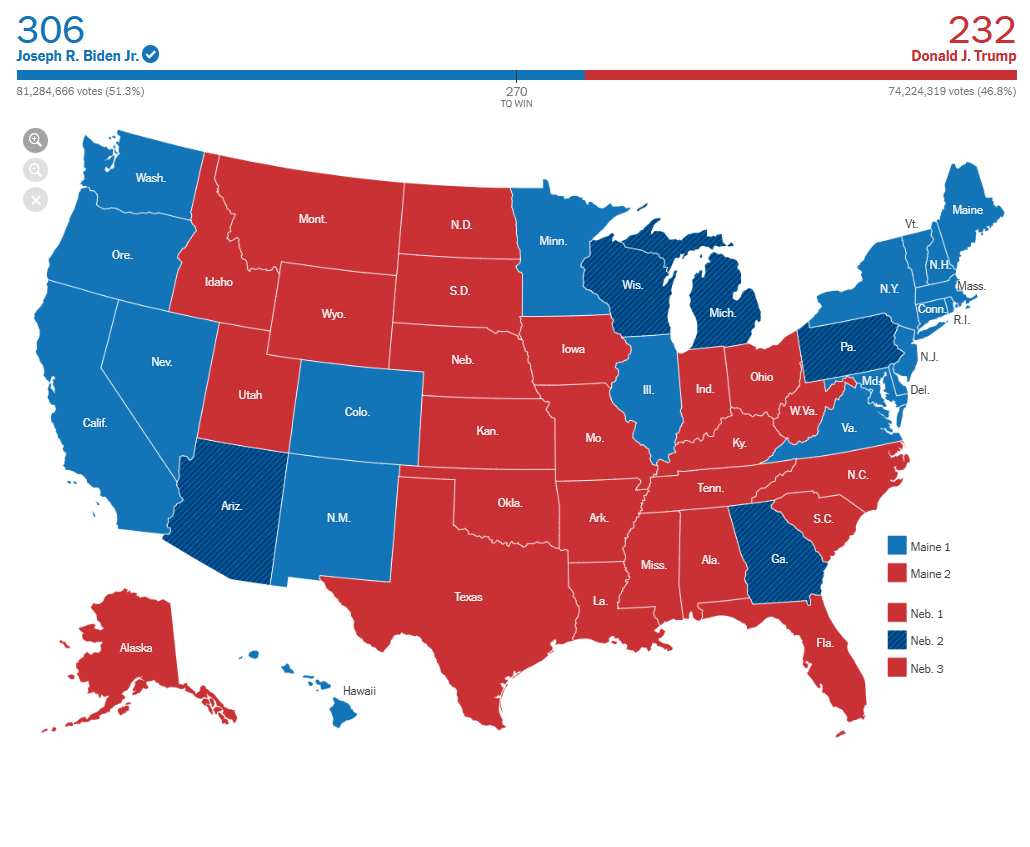
It seemed that a formal procedure for the transfer of power should have followed, but Trump refused it. He did not concede defeat and claimed that he actually won the election.
From this moment begins the worst chapter in his biography. Ahead of him are 4 criminal cases, a second impeachment, two assassination attempts, and once again Biden as an opponent in the 2024 elections.