Sedevacantism
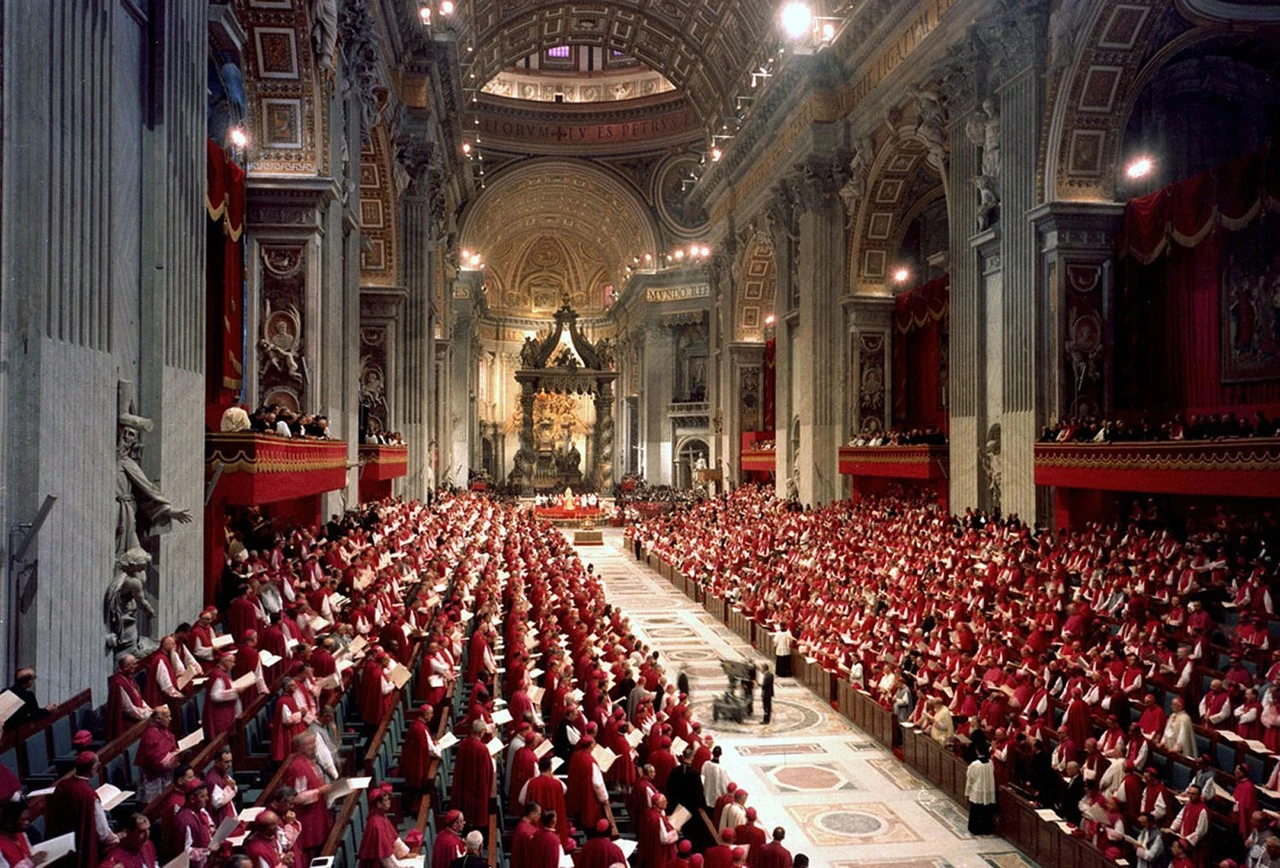
In the second half of the 20th century, the Catholic Church faced a serious crisis related to the confrontation between modernists and traditionalists. The most radical minority of the latter broke away from the Holy See, creating autonomous communities of sedevacantists—Catholics who do not recognize the current Popes and consider the papal throne temporarily vacant.
29.10.2025

Danila Frolov
Catholic blogger
Since the 1960s, the Catholic Church has been undergoing profound internal transformations and crises. Voices are increasingly calling for a reassessment of traditional aspects of doctrine, pastoral approaches, and forms of religious life. Against the backdrop of these processes, sharp debates have arisen within the Church about the limits of permissible renewal and the balance between fidelity to tradition and adapting to the spirit of the times. Some priests have actively engaged in socio-political life, which some see as a natural expression of Christian responsibility, while others view it as a symptom of losing spiritual bearings. Even the papal throne has not remained untouched: the pontificate of Francis is chiefly remembered for numerous discussions and scandals surrounding his words and actions. For some, these have become symbols of renewal and openness, while for others, they are reasons for criticism and bewilderment.
Although this crisis is neither the most severe nor the most extensive in history, and certainly not unsolvable, many people have become disillusioned with the Church and sought refuge elsewhere. One of the ideas that gained traction in this context is sedevacantism. The central tenet of this doctrine is the claim that the seven pontiffs who have led the Church since the opening of the Second Vatican Council—namely John XXIII, Paul VI, John Paul I, John Paul II, Benedict XVI, Francis, and Leo XIV—are antipopes, impostors unlawfully occupying the chair of St. Peter. This is how they explain the crisis that began after the Second Vatican Council—if the Church is led by impostors, they will obviously lead the Church away from God's will. And if they act against God, they should neither be listened to nor obeyed. Some sedevacantists have gone even further, believing that the Catholic Church is not merely mistaken but has actually perished, and that the Vatican is a false Church.
Before we delve directly into sedevacantism, it's important to note that not everyone who was displeased with the Council's reforms chose the path of sedevacantism. The most well-known among them is Archbishop Marcel Lefebvre and his Society of St. Pius X (FSSPX), who did not endorse the views and methods of the sedevacantists and preferred to remain in communion with the Holy See. To this day, the overwhelming majority of traditionalists prefer the path of unity with the Pope, engaging in dialogue with him about the extent of acceptable compromises. Sedevacantism is a marginal (and therefore intriguing) position, far removed even from the traditionalist mainstream.

Where did this movement come from, what is its current state, and what do its supporters believe? We will explore these questions in this article.
Origins of Sedevacantism
The first thing to note is that sedevacantism is not and never has been an "oppositional" Church existing parallel to the Vatican. We are dealing with an indeterminate number of various groups, often disagreeing with each other on important issues. Therefore, in this article, we will look at the most numerous and/or well-known groups, of which there are four:
The Palmarian Church. After the Second Vatican Council, one of the Vietnamese Catholic bishops, Ngo Dinh Thuc, found himself in a dire situation—a military coup in his homeland resulted in the murder of most of his family, the new government prevented his return, and Pope Paul VI used this to force him to resign. In deep despair, Thuc came to believe that a double was ruling instead of Paul VI and that those who convinced him of this should be made priests and bishops. Later, one of them declared himself the new Pope—Gregory XVII, and the new center of the Church—the city of Palmar in Spain. The Palmarian group still exists today under the leadership of Antipope Peter III and actively simulates a bustling activity.
The Society of St. Pius V (Societas Sacerdotalis Sancti Pii V, SSPV). Founded in 1983 by nine priests who left the Society of St. Pius X—a less radical group that, while challenging the Council's decisions, never adhered to sedevacantist positions. The SSPV operates only in the USA and Canada.
The Congregation of Mary Immaculate Queen (Congregatio Mariae Reginae Immaculatae, CMRI). Currently the largest and most cohesive sedevacantist organization. Founded in 1967 by Francis Schuckardt. Although Schuckardt was ordained a bishop, he received his ordination from Old Catholics—a group that split from the Catholic Church in the late 19th century after the First Vatican Council. He was later expelled from his own organization for drug abuse, sexual scandals, and other misconduct. Leadership was taken over by his close ally, Denis Chicoine, but the organization did not improve. Former members reported being subjected to extremely harsh corporal punishments (such as being forced to crawl on their knees on asphalt), being forbidden to watch TV or read the news, and being urged to separate from their spouse if they did not want to join the CMRI.
The Most Holy Family Monastery (MHFM). The smallest but loudest of all existing groups. It is known to consist of only two members—the brothers Peter and Michael Dimond. They live near the town of Fillmore in New York State, in the aforementioned monastery. Despite limited resources, they produce a colossal amount of content. They run the website vaticancatholic.com, a YouTube channel of the same name, and likely the sedevacantist media "Novus Ordo Watch." They have been active since the 1990s, initially distributing tapes and leaflets. Now, Peter Dimond regularly releases videos exposing the Vatican on YouTube. Little is known about Michael—his last photos and videos were from the 1990s, after which only his voice has occasionally been heard in videos. This has led to speculation that he is dead, although there is no evidence to support this.
What Do Sedevacantists Believe?
Like any decentralized movement, sedevacantism does not have a "declaration of principles" or equivalent. However, by listening to various groups and their opinions, three principles can be identified that more or less all sedevacantists adhere to:
All Popes after Pius XII, namely John XXIII, Paul VI, John Paul I, John Paul II, Benedict XVI, Francis, and Leo XIV, are antipopes, i.e., they unlawfully occupied their positions;
The Second Vatican Council is an illegitimate council, and its decrees contradict pre-conciliar teachings;
The ordination formulas for priests and the consecration of bishops established by the Second Vatican Council are erroneous, meaning that all priests and bishops ordained under them are not truly ordained.
Different groups of sedevacantists prioritize these three points differently and describe their technical implementation in various ways. However, these three principles are present in almost all.
What Are Your Proofs?
To prove their first point—the illegitimacy of all post-conciliar popes—sedevacantists typically point to numerous scandalous actions and statements by various popes. For example:
John Paul II kissed the Quran;
John Paul II met and prayed with representatives of other religions;
Francis supports same-sex marriages;
Francis brought pagan idols into the Vatican;
Francis said that all religions are equal.
All this, according to sedevacantists, represents a departure from the Church's previous teachings. And if a person has fallen into heresy and excommunicated themselves from the Church, how can they hold a position within the Church? From this, it is concluded that post-conciliar popes held their positions unlawfully.
Next comes the second point—the illegitimacy of the Second Vatican Council. Here, excerpts from the Council's documents are used, which, according to sedevacantists, can be interpreted in two ways. One of the most popular examples:
"But the plan of salvation also includes those who acknowledge the Creator, and among them, especially the Muslims, who, professing to hold the faith of Abraham, along with us adore the one and merciful God, who on the last day will judge mankind."
Lumen Gentium, 16
Pointing to such passages, sedevacantists draw a conclusion similar to that about the popes: the Council contradicts previous Church teachings, and therefore it is heretical and illegitimate.
The third argument is the illegitimacy of priestly ordinations. According to sedevacantists, the new ordination formula lacks mention of the sacramental nature of the priesthood, i.e., the duty to offer sacrifices to God. As evidence, they refer to Pope Leo XIII, who for the same reason declared Anglican ordinations illegitimate. Consequently, if this logic is applied consistently, ordinations performed after the Second Vatican Council should be equated with Anglican ones and rejected.
Gaps in Sedevacantism
The first issue faced by anyone trying to understand the sedevacantist position is the chicken-and-egg problem between their two key positions. There can be two scenarios:
The last seven popes are illegitimate because they approved a heretical Council;
The Second Vatican Council is illegitimate because it was approved by an antipope.
Both scenarios have obvious flaws. In the first case, the logic is disrupted by the first "antipope" on the sedevacantist list—John XXIII, who convened the Second Vatican Council but died before it made any decisions. In the second case, the key "antipope" becomes John XXIII's successor, who approved the Council's decisions—Paul VI. This hypothesis has even more problems—sedevacantists must somehow explain the fact that several thousand senior hierarchs of the Catholic Church, most of whom were appointed by Pius XII, simultaneously fell into heresy, elected an Antipope, and then signed off on the Council's decisions. Even those hierarchs who opposed the reforms were not sedevacantists and did not go into schism.
In an attempt to prove their first argument, sedevacantists often use a tactic known as Gish gallop—overwhelming the listener with a stream of scandalous facts and statements by popes, preventing thoughtful consideration of each case. But if these examples are examined individually, they turn out to be not so clear-cut. For instance, it is still unclear whether Pope John Paul II knew he was kissing the Quran and not the Bible in Arabic—since Catholic hierarchs from Arab countries were also present at the event.
Similarly, when it comes to the Second Vatican Council, sedevacantists often take quotes out of context to support a pre-existing narrative. In the same Lumen Gentium that speaks of Muslims, there is another, less frequently cited passage:
"Based upon Sacred Scripture and Tradition, it teaches that the Church, now sojourning on earth as an exile, is necessary for salvation... Hence they could not be saved who, knowing that the Catholic Church was founded as necessary by God through Christ, would refuse either to enter it, or to remain in it."
Lumen Gentium, 14
This passage completely undermines the claim that the Council supposedly "abolished the necessity of the Church for salvation."
Finally, the argument about the "illegitimacy" of the ordination formula simply does not hold up: the new formula contains the words "May Jesus preserve you to sanctify the Christian people and to offer sacrifice to God," meaning the necessary mention was not removed. To this, sedevacantists respond with nothing but "it doesn't count," for reasons known only to them.
Conclusions
In conclusion, it should be said that the main problem with sedevacantism is not weak arguments. The movement was doomed to remain marginal due to its radicalism and reactionary nature. On one hand, convincing even a significant portion of Catholics that they have been without a Pope for almost 70 years, that the Church has effectively died, and that this is not a problem, is an impossible task. Even in traditionalist circles, this viewpoint remains marginal, while the majority seek solutions to the current crisis in unity with the Church. On the other hand, sedevacantism is a product of this very crisis and will likely end with it. Ultimately, sedevacantism will be destroyed by what destroys any radical and reactionary movement—the resolution of the crisis through more moderate methods.