History

Konstantin Tarasov
Historian, author of the Telegram channel “Bolshie pozhary”
00:00
"Russia, inarticulate and long silent, suddenly began to speak with an incoherent but insatiable voice – it couldn't stop talking." This is how writer Boris Zaitsev recalled the first days after the fall of the monarchy. In the spring of 1917, the familiar order collapsed, and the space of freedom, barely emerging, was filled with the hum of thousands of voices. Newspapers multiplied by the dozens, meetings and rallies went on incessantly, and intersections turned into platforms. Every word, every thought seemed significant, as if the fate of the country depended on them. Some eagerly listened to new slogans and promises, while others were bewildered, trying to understand what lay behind the flow of new words and expressions.
This was not the first time such events occurred in history. French Revolution researcher Keith Baker long ago suggested viewing such pivotal periods as times of fundamental restructuring of the language of communication. Familiar words and expressions suddenly cease to work; they no longer explain what is happening and do not allow people to agree on the future. In 18th century France, the king's subjects suddenly became citizens, and the kingdom turned into a republic. Old concepts are replaced by new ones, opening up new horizons.
During revolutions, society undergoes radical transformations. Familiar hierarchies collapse, new political phenomena emerge, and there is an acute need to explain what is happening. Words become the "building blocks" from which a new worldview is constructed. With their help, new identities are created, society is divided into "us" and "them," and hope and hatred are born.
It cannot be said that such a radical change occurs smoothly. The vocabulary of the era becomes a living testimony to the struggle for the right to describe reality and define its meaning. Each side offers its own interpretation of the conflict and tries to cement it in words. Some terms begin to sound solemn and mobilizing, others acquire a stigma of hostility, and still others become taboo.
In Russia in 1917, the first lines of division began to appear in language. Initially, speech seemed to be a space for seeking new common meanings, a way to unite people. But very soon it turned into a tool of division: slogans and labels became brands, turning opponents into "enemies." Language ceased to unite; it began to divide. The political vocabulary of 1917 turned into an alphabet of hatred, from which the Civil War soon grew.
Democracy and the People
In 1917, the word "democracy" was heard everywhere and for various reasons: "democratic republic," "democratic freedoms," "democratization of the army," "revolutionary democracy". But back then, it did not mean quite the same thing as we understand democracy today. For the participants of the revolution, it was not only a political system with rights and freedoms but also a name for certain social groups. When they said "democracy," they often meant "working classes," "lower strata" of society, primarily workers, soldiers, and peasants.
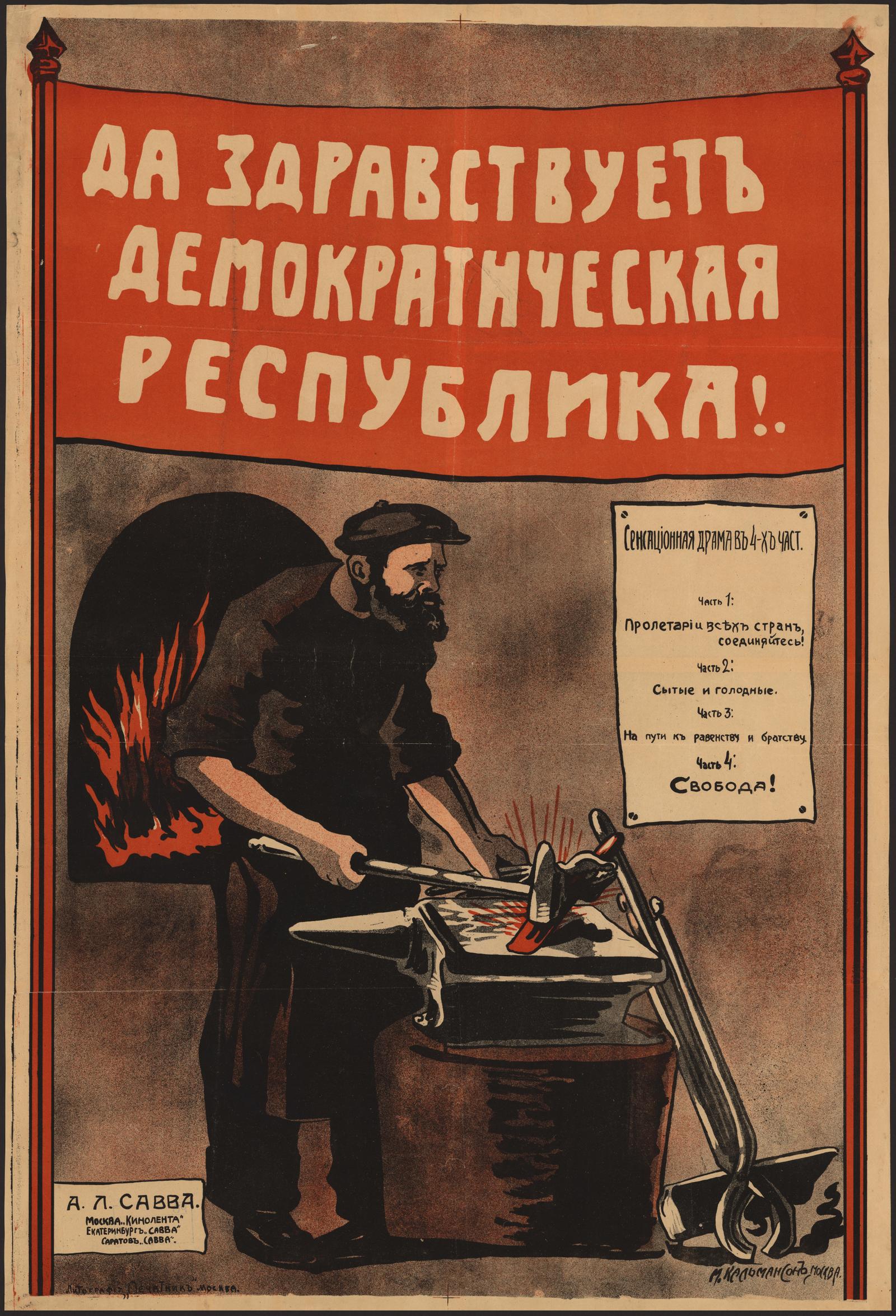
In his famous speech on March 2, 1917, at the meeting of the Petrograd Soviet, the popular politician of the time, Alexander Kerensky, emphasized: "...I am a representative of democracy, and the Provisional Government must look at me as the voice of the demands of democracy and must especially consider those opinions that I will defend as a representative of democracy, through whose efforts the old power was overthrown." Essentially, he positioned himself as the sole voice of "democracy" in the entire government, thereby excluding liberal politicians from its representatives.
This usage highlighted the special position of the "lower classes" and their claim to new civil rights. But at the same time, this rhetoric had a reverse side: it displaced the former privileged groups from the political process. "Democracy" was opposed to the "bourgeoisie," and the very logic of the language set a strict demarcation between "us" and "them." As a result, the word, seemingly associated with equality and participation, became a tool of exclusion and a symbolic weapon in the emerging civil war.
Sharp debates unfolded around another key concept of democracy – the people. After the fall of the monarchy, lawyers began developing new laws in which the bearer of power was now declared to be "the people in its entirety." Actions directed against "organs of the people's will" were now regarded as rebellion. Thus, supporters of General Kornilov, who attempted to establish a military dictatorship, were declared "enemies of the people" because their actions were seen as directed against the interests of the entire population.
However, in the Russian language, the word "people" has a double meaning. On one hand, it denotes the entire population of the country, and on the other, it specifically means the "lower classes" of society, the "common people." This ambiguity also affected the political programs of the parties.
Members of the liberal Cadet party spoke of the people as the nation as a whole, including all citizens: workers, peasants, intelligentsia, and the "bourgeoisie." The Social Revolutionaries in their programmatic documents proclaimed the protection of the "working people," which no longer included the upper classes of society. The Bolsheviks, and Lenin in particular, primarily supported the workers, as they believed the proletariat held the future, and it was the true representative of the interests of the entire people and even all of humanity.
This created fertile ground for mutual accusations. Socialists saw the Cadets as defenders of the interests of the "bourgeoisie," while the Cadets, in turn, accused the socialists of narrow political thinking and favoring one social group over others. Thus, the concept of the people itself reinforced dividing lines among politicians.
Freedom and Justice
"Liberty, equality, and fraternity" – these words shone not only on the banners of the French Revolution but also on the streets of Russia in 1917. But everyone heard something different in them. For liberals, "freedom" meant the constitution, elections, equality before the law, and protection of individuals from the arbitrariness of power. For socialists, it was primarily liberation from exploitation, the right to work and live humanely.
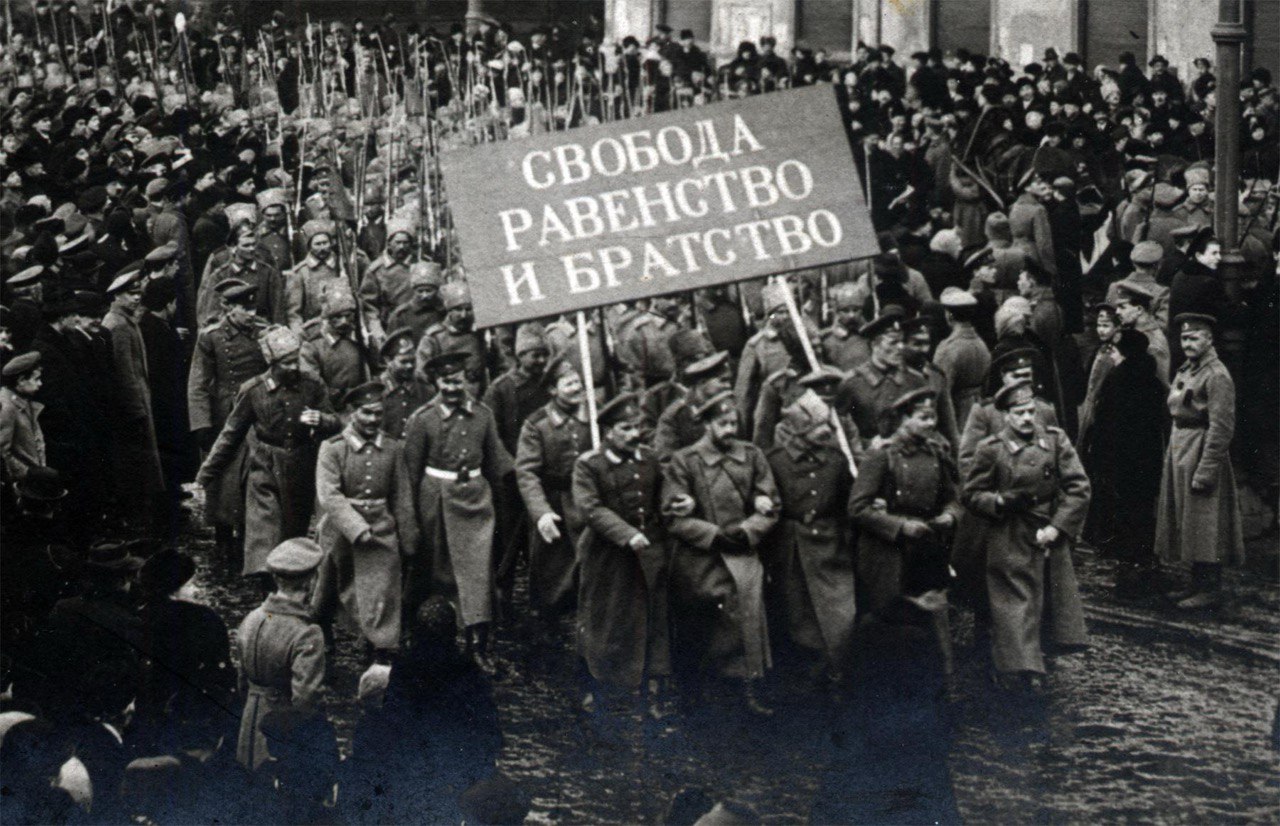
For many people in 1917, freedom primarily meant liberation from the former slavery and tyranny associated with the tsarist autocracy. Revolutionary politicians and publicists repeatedly stated: Russia had become "the freest country in the world." This freedom was seen as a guarantee of a new life—without a tsar, without police and censorship, with the right to speak and act openly. It was perceived as the fulfilled dream of the fallen "fighters for freedom."
But freedom also had another, darker side. For some people, it turned into permissiveness, a rejection of any rules and restrictions. Sociologist Pitirim Sorokin recalled: "On the streets, I saw many drunk people swearing and shouting: 'Long live freedom! Today everything is allowed!'" A wave of street riots, rising crime, and mass disobedience to authorities showed that many people understood freedom as the right to do whatever they wanted, regardless of the law and common interests.
To preserve the true meaning of freedom, socialists tried to explain it to people. One of the provincial Soviets wrote: "To be free, fellow citizens, does not mean having the right to do what I want, but what the majority wants." But the more often the word "freedom" was spoken, the more it turned into a weapon of political struggle. After the July events, when the Provisional Government was under threat of overthrow, arrests, suppression of rebellious military units, and peasant unrest were also justified as the defense of freedom.
The concept of "justice" turned out to be just as multilayered. For moderate politicians, it meant equality for all before the law, the expansion of political rights, and the elimination of old class barriers. In their understanding, justice is when every citizen has equal opportunities and equal protection from the state.
But what was balance for some was a revolution for others, in which the old social hierarchy was turned upside down. Justice was seen as a long-awaited social revenge: the rich should yield to the poor, the "upper classes" should answer for the past. In peasant villages, justice was considered the redistribution of landowners' land, in working-class neighborhoods—the redistribution of income and power.
Dissatisfied representatives of the intelligentsia called the revolution the coming kingdom of Ham, disdainfully commenting on the cab drivers' desire to earn more from wealthy clients, soldiers' desire to subordinate officers, and proletarians' desire to lead the country. Even behavior on the tram seemed symbolic, when residents of poor outskirts "mercilessly stepped on the feet of 'bourgeois' and stained the white skirts of 'bourgeoises'."
Bourgeois and Comrade
The word "bourgeois" became one of the most recognizable and fierce labels of the revolutionary era. Before 1917, the intelligentsia often used the similar term "bourgeois" in an ironic or derogatory sense as a synonym for lack of spirituality, petty-bourgeois taste, and low cultural needs. Russian socialists gave this word an additional, class connotation, turning it into a designation for "exploiters." But in the revolutionary year, its meaning expanded even further. Brochures and newspapers noted: "Who is not called a bourgeois now? Workers call all non-workers bourgeois, peasants call all sorts of 'masters' bourgeois, including essentially everyone dressed in city clothes..."
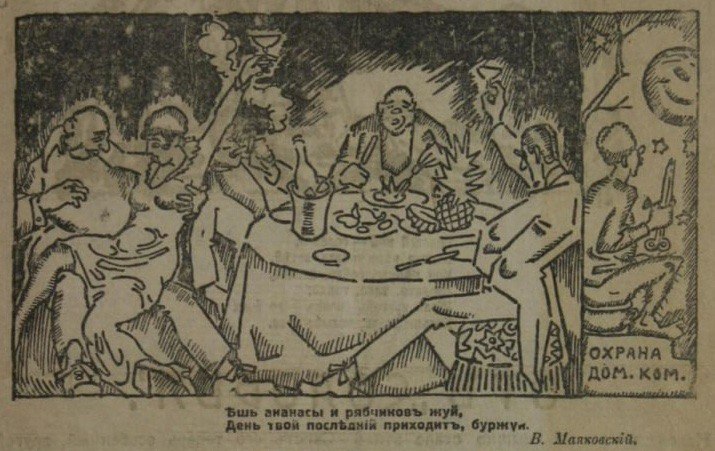
Thus, "bourgeois" ceased to be a strictly Marxist term. It was used to denote anyone perceived as "alien" and "guilty" of the people's woes. The language of class struggle perfectly aligned with the real social tension between the rich and the poor, the privileged and the oppressed. The habit of thinking through class oppositions formed a new social reality, where the debate was no longer about politics, but about who was "one of us" and who was "an outsider."
The word "comrade" became another central symbol of the revolutionary era. In pre-revolutionary political culture, as in Western Europe, it had a narrow meaning—"party fellow-thinker," a person of the same views and beliefs. In the Russian context by 1917, it was firmly associated with socialists.
In the days of the monarchy's fall, the address "comrade" acquired truly transformative power. Jurist N. V. Ustryalov recalled the impression made by the first soldiers who sided with the people: "I clearly remember the deep, stirring impression made on February 28 by the first soldiers who sided with the people, addressing the crowd with the word 'comrades,' which was unusual in their mouths. <...> And it was joyful, light at heart, and indeed, all these unfamiliar people in the square seemed like family, comrades, brothers." In this address, a new language of solidarity was born, a sense of universal unity.
But very soon "comrade" became a source of polarization. The intelligentsia began to use this word in an ironic, and then in a derogatory sense. Initially, the mockery was directed at the socialists themselves, then at their supporters, and later the word became associated with all the "lower" strata of the population. A Petrograd official recorded in his diary a joke about the French minister Albert Thomas, who after a trip to Russia remarked: "They are charming, these comrades, but it is very strange that they do not wear rings in their noses!"
Thus, "comrades" turned into a collective image of rude, uncultured, greedy, and impudent people. The same word could mean either fraternal unity or social contempt. In this ambivalent meaning, the nature of revolutionary language was manifested: it not only created new forms of closeness but also reinforced new lines of alienation, turning speech into a weapon of social division.
Counterrevolution and Anarchy
In revolutionary rhetoric, language ceases to be merely a means of describing reality and turns into a weapon of mobilization. Words begin to perform the function of commands, slogans, and alarms. In conditions of constant political struggle, labels that justify the use of force acquire special significance.
One of the most powerful labels became the word "counterrevolution." It had no precise definition, but that was precisely its strength: in the mouths of revolutionaries, a "counterrevolutionary" could be anyone who hindered the implementation of radical transformations. This definition included monarchists and officers, liberals and moderate socialists, entrepreneurs, and even peasants who resisted agrarian policy. "Counterrevolution" became a universal accusation, and therefore—a ready justification for repression, violence, and political exclusion.
The stigma of "counterrevolution" was placed not only on "right-wing" opponents of the revolution. Attempts to overthrow the Provisional Government "from the left," by the Bolsheviks and their allies, were also declared counterrevolutionary. In the July Days, when mass protests against the government erupted in Petrograd, they were seen as a threat to the revolution itself. Left radicals were accused of undermining authority with their actions and effectively aiding the enemy. Politician and publicist Alexander Klyvansky wrote that "objectively, the Leninists worked for the German General Staff and for the Russian counterrevolution,"—that is, the Bolsheviks were directly equated with agents of Russia's enemies.
Menshevik I. G. Tsereteli saw an even greater danger in the unrest. According to him, civil war is the only way by which counterrevolution can come to power and "bury the revolution." For him, chaos and internal conflicts meant a direct path to the restoration of the monarchy or the establishment of a military dictatorship. Thus, even actions under the slogans of the "left" opposition were interpreted as a threat of returning to the old order.
Hence, the word "anarchy" became an equally dangerous stigma. It was used to denote chaos, lawlessness, destruction—all that threatened order and stability. Fear of anarchy was one of the leading themes of journal satire in 1917, touching on both "domestic" anarchy (lynchings, robberies) and "political" (the threat of civil war).
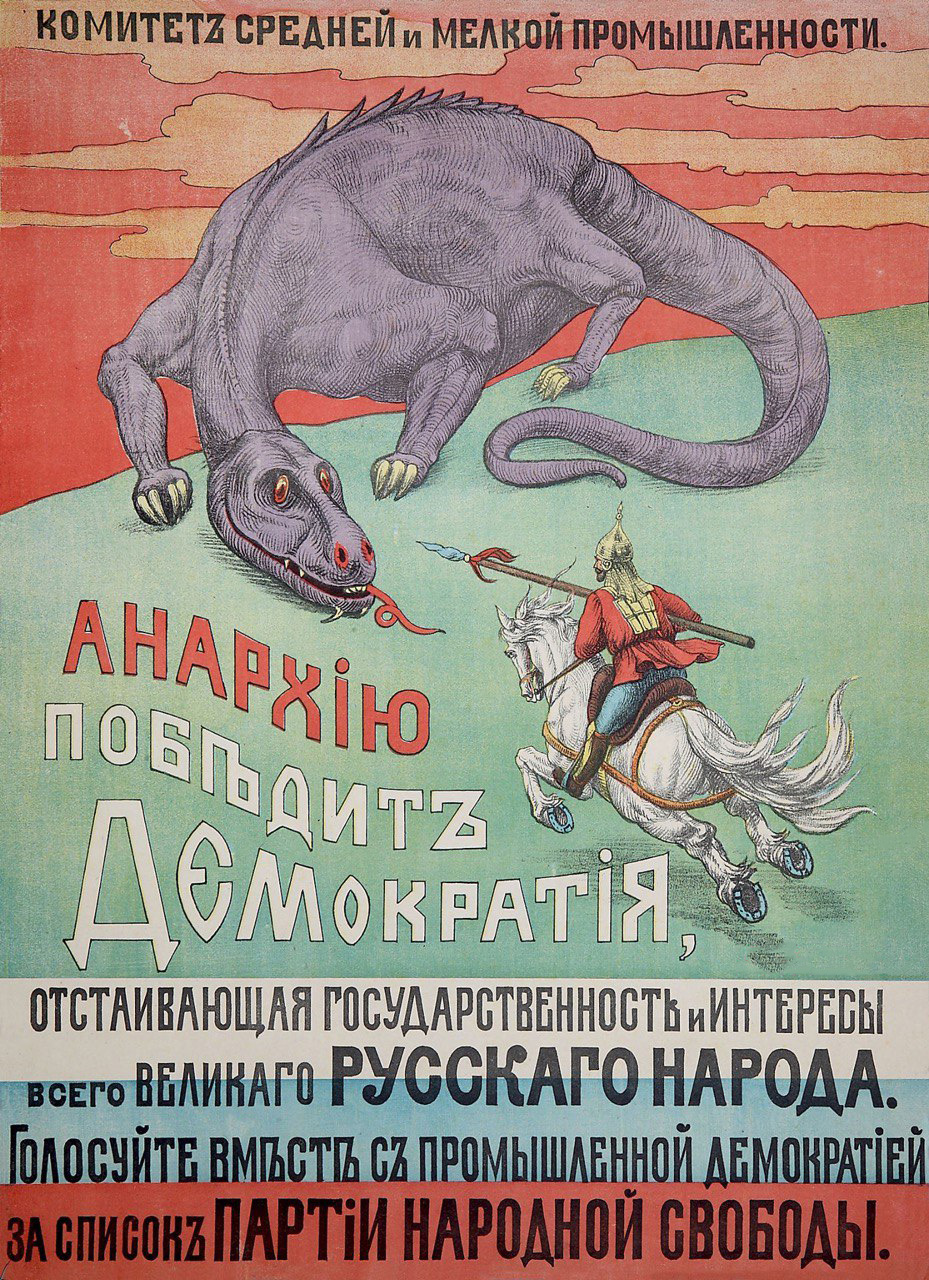
Almost all political parties and movements (except for the anarchists themselves) spoke of the danger of "anarchy." The need to fight "anarchy" became an important tactic for legitimizing power, justifying its strengthening, curtailing democracy, and establishing a dictatorship. "Anarchy" in revolutionary language was not a description of the real state of affairs but a tool for intimidation and discreditation.
These two words – "counter-revolution" and "anarchy" – worked as opposing poles of the same discursive field. The first was used to fight the "right," the second to fight the "left." In both cases, they served as mobilizing labels that left no room for doubt or compromise. Thus, the language of revolution reshaped public consciousness: instead of discussions – accusations, instead of arguments – stigmas, instead of political competition – a war of words, which inevitably led to real war.
***
The culture of civil war and its language are formed long before the first battles. In the revolutionary months, participants in conflicts learned to think in terms of irreconcilable enmity, and words became the main weapon of this struggle. The "language of hatred" – or, if you prefer, the language of political struggle, saturated with negative connotations – was used to analyze the situation, justify violence, mobilize supporters, and discredit opponents. Every word was intended not only to explain the world but also to change it, not only to describe the enemy but also to prepare for their destruction.
The legitimization of violence is impossible without convincing and vivid images of enemies, and it was precisely on their creation that enormous efforts of revolutionary rhetoric were spent. In newspaper headlines, slogans, agitational brochures, and rally speeches, language constructed a new reality where there was no room for doubt or compromise. Words became a call to action, and the hatred cultivated in speech inevitably manifested in violence. Thus, the Civil War began long before the first shots were fired: it began in words.